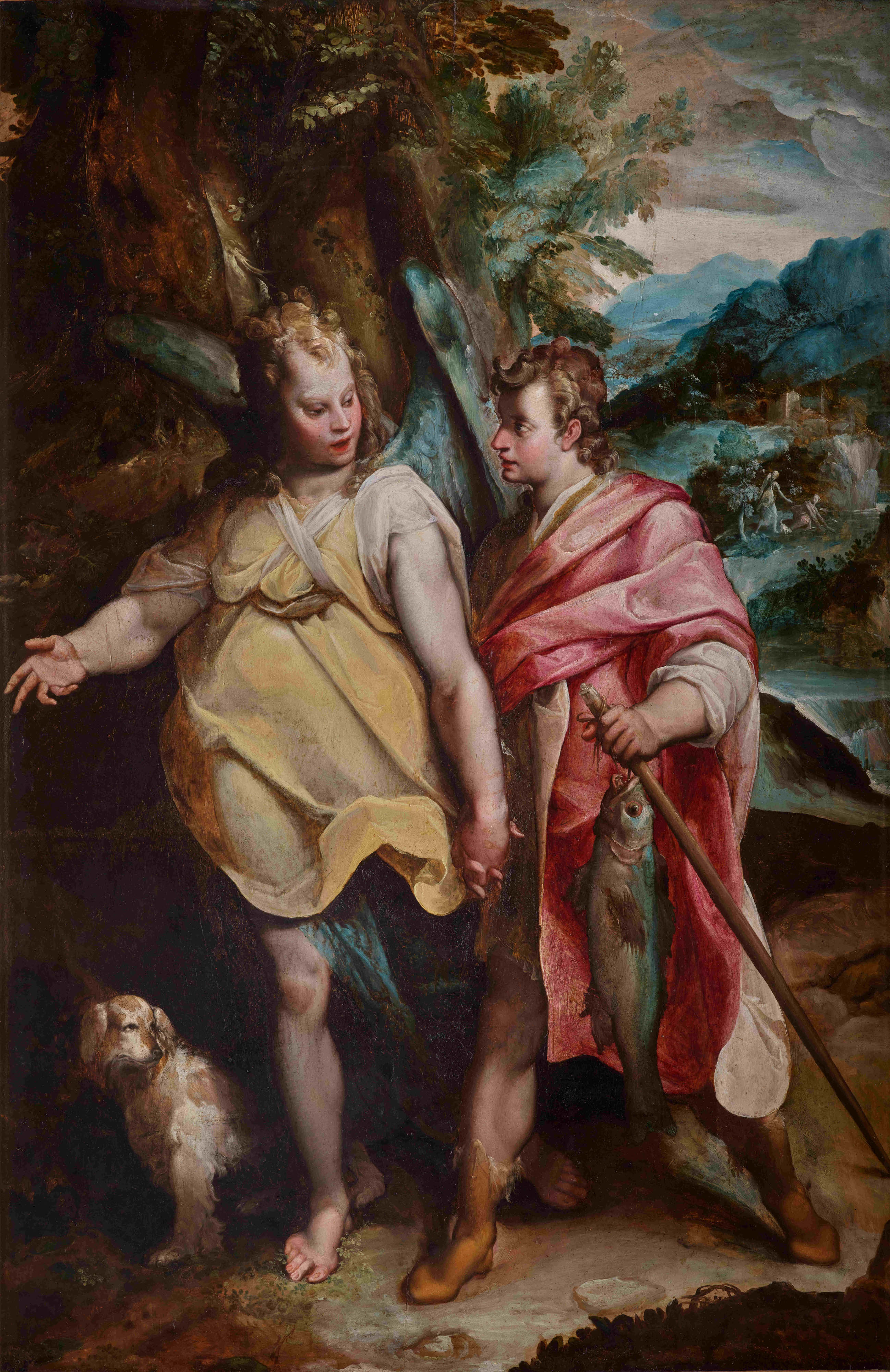
Identified by critics as the painting executed for Countess Santafiora of Sala Baganza, it had become part of the Borghese Collection by 1650, when it was mentioned with the correct attribution to Raffaellino da Reggio. The panel depicts the famous Biblical episode of Tobias guided by the angel during his journey of redemption. It was executed by Raffaellino in around the 1570s, the period in which he clearly came under the influence of Flemish painting, as is evident in both the changes in his chromatic range and in the open landscape of the background.
Sala Baganza, Santafiora family, 1616 (Fantini 1616; Faldi 1951); Rome, Borghese Collection, 1650 (Manilli 1650); Inventory 1693, room VII, no. 14; Inventory 1790, room I, no. 21; Inventario Fidecommissario Borghese 1833, p. 40. Purchased by Italian state, 1902.
Exhibitions
1952 - Napoli, Mostra d'Oltremare;
1995 - Roma, Palazzo delle Esposizioni;
1995 - Bruxelles, Palais des Beaux-Arts;
2009 - Ottawa, National Gallery of Canada.
Conservation and Diagnostic
1950 Augusto Cecconi Principi (Restoration)
1982-1983 Gianluigi Colalucci (Restoration)
2009 Laura Ferretti (Restoration)
Catalogue entry
A painting of this subject by Raffaellino da Reggio is recorded by Bonifacio Fantini (1616) in the collection of the noble Sforza di Santa Fiora family at Sala Baganza: “A Sala, luogo del Parmigiano, si vedono due Quadri fatti per la Contessa Sanfiore [sic]; in uno la natività di Ercole …; e nell’altro Raffaelle, e Tobia: opera così rara, che poi fu posta alle stampe pel modo, che tiene nel mostrare la meraviglia del Giovine Tobia, e la maestà dell’Angelo”. In 1951, Italo Faldi identified the present panel with the painting mentioned by Fantini, noting that it was already documented in the Borghese collection by 1650 (Manilli).
The attribution of the painting has never been questioned by scholars and is supported by a drawing identified by Adolfo Venturi (1893) in the Gabinetto dei Disegni e delle Stampe at the Uffizi in Florence (inv. 2014 F; Bolzoni 2016, pp. 153 fig. 10, 185, no. A7). The attribution is further reinforced by a study for the figure of Tobias published by Gere and Pouncey in 1983 (Rennes, Musée de Rennes, inv. 794.1.2523), as well as by several related sheets (Florence, Uffizi, inv. 2019 F, Bolzoni 2016; Paris, Musée du Louvre, inv. 11210, A. Bigi Iotti, G. Zavatta, in From Raphael to Carracci 2009; Reggio Emilia, private collection, Winkelmann 1977). In addition, three prints, by Agostino Carracci (Fantini 1616; Malvasia 1678; Ramhdor 1787; Voss 1920), Matthias Greuter (F. Sricchia Santoro, in Fiamminghi a Roma 1995), and an anonymous engraver, reproduce the present composition, further attesting to its authorship and dissemination. According to Beretta (1984-85), however, these prints derive from the Uffizi drawing rather than directly from the panel itself, while Bartsch (1802–1821, XVIII, pp. 36–37, no. 3), who cast doubt on the Carracci engraving’s authorship, suggested that the date “1581” was added at a later stage.
The subject, already treated by Raffaellino in a fresco in the Sala degli Angeli at Caprarola, shows the young Tobias accompanied by the Archangel Raphael, holding the large fish whose liver will later be used to heal his father's blindness. Licia Collobi (1938), followed by Bologna and Causa (in Fontainebleau 1952) and later by Della Pergola (1955), placed the painting among the artist’s final works, noting its close stylistic affinities with the decoration of the second chapel on the left in San Silvestro al Quirinale. This hypothesis was firmly rejected by Faldi (1951), who instead saw the panel as one of the painter’s earliest Roman works, executed around 1570, when, together with the architect Francesco Capriani da Volterra, the Emilian artist arrived in Rome and quickly assumed a prominent role in the city’s artistic scene (see De Mieri 2012).
Subsequent scholars have placed the painting at varying points in Raffaellino’s Roman production. Huys (1999) associated it with his activity at Caprarola and in the Vatican, suggesting a date between 1574-1575 and 1576. De Grazia (1984) dated it to 1575-1576, while Bigi Iotti and Zavatta (in From Raphael to Carracci 2009) placed it shortly after 1575. Bernardini (2002), reassessing the overall chronology of the artist’s oeuvre, dated the works at the Oratory of the Gonfalone and the Santi Quattro Coronati in Rome to 1573-1574, postponing the execution of the panel to around 1577, concurrently with the frescoes at San Silvestro al Quirinale. In 1995, Fiorella Sricchia Santoro proposed a date of around 1573, noting affinities with the work of Jacopo Zanguidi, known as Bertoia, at the Gonfalone, and with Raffaellino’s own paintings at Caprarola.
L. Collobi, Raffaellino Motta detto Raffaellino da Reggio, in “Rivista dell’Istituto d’Archeologia e Storia dell’Arte”, I, 1938, p. 273;
I. Faldi, Contributi a Raffaellino da Reggio, in “Bollettino d’Arte”, XXXVI, 1951, pp. 330, 332-333; Fontainebleau e la maniera italiana / Mostra d'Oltremare e del Lavoro Italiano nel Mondo, catalogo della mostra (Napoli, Mostra d'Oltremare, 1952), Firenze 1952, pp. 43-44, n. 78;
P. della Pergola, La Galleria Borghese. I Dipinti, I, Roma 1955, pp. 63-64;
G. Briganti, La maniera italiana, Roma 1961, p. 55;
A. Hauser, Der Manierismus, Torino 1965, p. 217;
D. de Grazia, Correggio e il suo lascito. Disegni del cinquecento emiliano, catalogo della mostra (Parma, Palazzo della Pilotta, 1984), a cura di Diane de Grazia, Parma 1984, p. 362;
S. Beretta, Raffaellino da Reggio e i suoi incisori, «Rassegna di Studi e Notizie», XII, 1984-1985, pp. 22-28;
A. Coliva, a cura di, La Galleria Borghese, Roma 1994, p. 152;
F. Scricchia Santoro, in Fiamminghi a Roma 1508-1608. Artistes des Pays-Bas et de la Principauté de Liège à Rome à la Renaissance, catalogo della mostra (Roma, Palazzo delle Esposizioni, 1995; Bruxelles, Palais des Beaux-Arts, 1995), Gand 1995, pp. 288-289;
F. Scricchia Santoro, in Fiamminghi a Roma 1508-1608. Artisti dei Paesi Bassi e del Principato di Liegi a Roma durante il Rinascimento, catalogo della mostra (Roma, Palazzo delle Esposizioni, 1995; Bruxelles, Palais des Beaux-Arts, 1995), Milano 1995, p. 231;
J.F. Huys, Raffaellino da Reggio (1550-1578). La personnalité d'un jeune artiste maniériste, in " Annales d’histoire de l’art et d’archéologie", XXI, 1999, pp. 49, 52-55;
C. Stefani, in P. Moreno, C. Stefani, Galleria Borghese, Milano 2000, p. 335;
M.G. Bernardini, L'Oratorio del Gonfalone a Roma, Milano 2002, p. 91;
K. Herrmann Fiore, Galleria Borghese Roma scopre un tesoro. Dalla pinacoteca ai depositi un museo che non ha più segreti, San Giuliano Milanese 2006, p. 98;
A. Bigi Iotti, G, Zavatta, Raffaellino da Reggio (1550-1578). Tracce di una biografia artistica, s.l. 2008, pp. 25, 28-29;
A. Bigi Iotti, G. Zavatta, in From Raphael to Carracci. The art of Papal Rome, catalogo della mostra (Ottawa, National Gallery of Art, 2009), Ottawa 2009, pp. 325-327, n. 100;