(Chalons sur Marne, notizie dal 1532 - c. Avignone 1562)
Copy link
Open link
Copied!
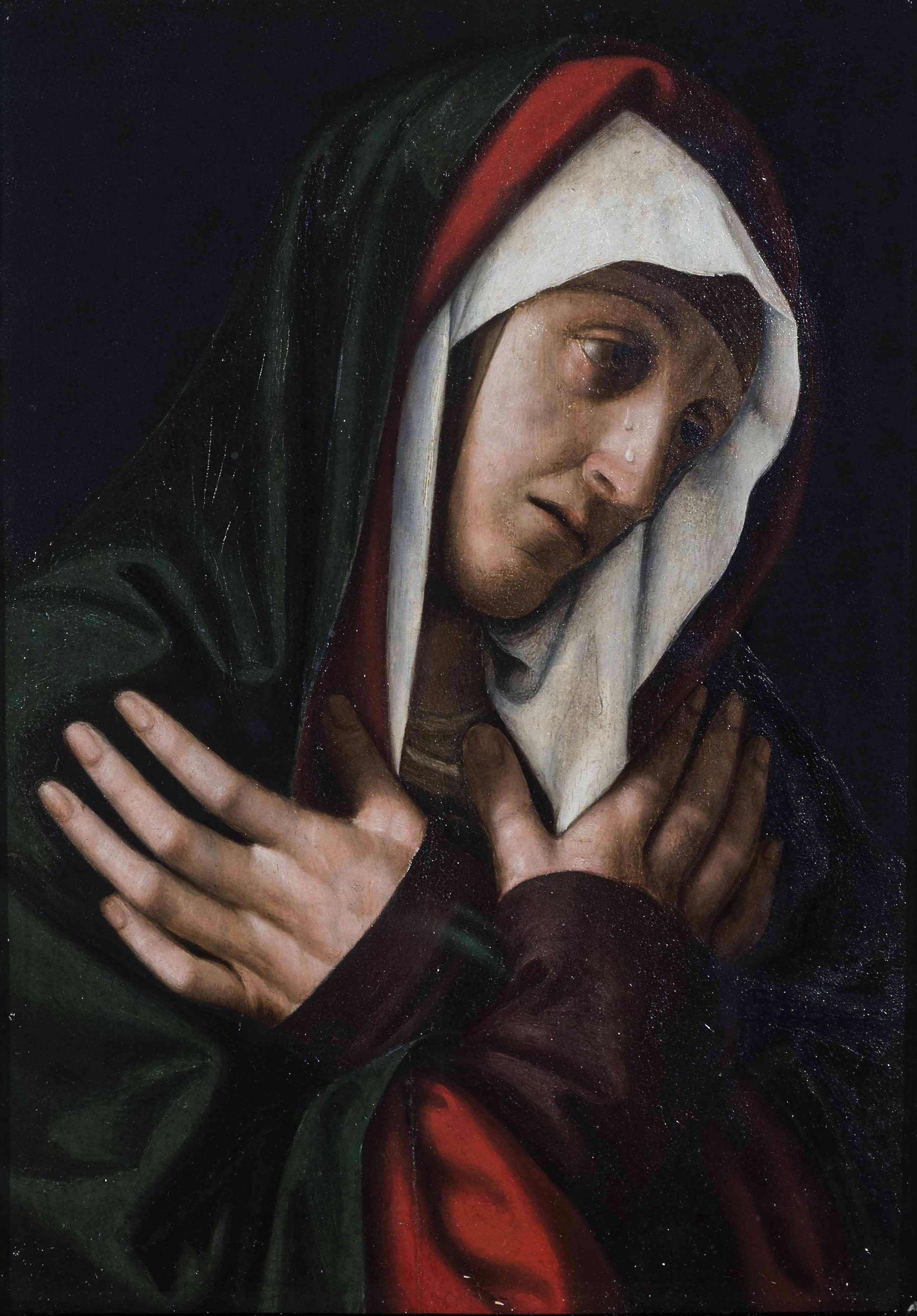
First documented in connection with the Borghese Collection in the 17th century, this painting was executed together with an Ecce Homo (inv. no. 286) by the French painter Symon de Châlons, whose signature is still legible on the back of the panel. It probably came into the possession of Cardinal Scipione Borghese during his legation in Avignon. The work shows Our Lady of Sorrows, who is portrayed against a dark background with her hands folded across her chest. Mary wears a green cloak over two veils, one red and the other white. Her attire highlights her moved expression, creating a powerful image intended to involve the observer emotionally and stimulate profound reflection in him/her.
(?) Rome, collection of Scipione Borghese, ante 1633 (Venturi 1893); Inventory 1693, room I, nos 21-22 (Della Pergola 1959); Inventory 1790, room X, nos 29-30; Inventario Fidecommissario Borghese 1833, pp. 18, 20. Purchased by Italian state, 1902.
Inscriptions
On the reverse: “SYMON DE CHA/LONS EN CHAPEINE MA PEINE/1543”
Exhibitions
2009 - Illegio, Casa delle Esposizioni
Conservation and Diagnostic
1903-05 - Luigi Bartolucci (panel support)
1996-97 - Carlo Ceccotti (panel support, frame)
2006-07 - Paola Tollo
Catalogue entry
The panel, together with its pendant depicting the Ecce Homo (inv. 286), is listed in the Borghese collection from 1693 onwards. Previously attributed to Federico Zuccari, to the school of Leonardo (Venturi 1900), and to Raphael (Jahn Rusconi 1906), the work was correctly reassigned in 1877 (Lafenestre, Richtenberger 1877; Frizzoni 1899) to its true author, the French painter Simon de Mailly. The attribution was confirmed when his signature was discovered on the reverse during the transfer of paintings from the palace to the villa in preparation for their sale (Piancastelli 1891).
Camille Larraz (2022) has extensively discussed that the diptych in question is not an entirely original invention by the artist, but rather derives from earlier, more established models. The Christ panel is based on a now-lost prototype (Larraz 2021), variously identified with an Ecce Homo in Leipzig (T. Borenius, in Crowe and Cavalcaselle ed. 1912) or a painting formerly held in Paris (Lafenestre, Richtenberger 1905). The Virgin, meanwhile, has been linked to a work by Andrea Solario (Della Pergola 1959; Cogliati 1965; Larraz 2022), painted between 1507 and 1509 in France, during the period when Simon de Châlons was in the service of the legate of Avignon, Georges d'Amboise. It was in this context that de Mailly had the opportunity to make a copy of the composition (Béguin 1985, p. 46).
It is noteworthy that in 1543, the date inscribed on the reverse of the Mater Dolorosa, the painter is documented in the Provençal city, where he signed the Holy Kinship (Sacra Parentela), wich is now housed at the Musée Calvet in Avignon (inv. D 907.4; Larraz 2022, p. 179, no. I.4), thus earning the designation of fabricant de tableaux pieux (“maker of devotional paintings”; Zarner 1996). In considerations of this and drawing on a suggestion put forward by Adolfo Venturi (1893), it can be hypothesised that the two panels, which remained in Avignon, later entered the prestigious collection of Cardinal Scipione Borghese during his legation in the Provençal city.
R. Longhi, Precisioni nelle Gallerie Italiane, I, La R. Galleria Borghese, Roma 1928, p. 202;
A. De Hevesy, Les élèves de Léonard de Vinci. Andrea Solario, in “Gazette des Beaux-Arts”, XIX, 1929, p. 183:
A. De Rinaldis, La Galleria Borghese in Roma, Roma 1939, p. 47;
P. della Pergola, La Galleria Borghese. I Dipinti, II, Roma 1959, p. 173, n. 254;
P. della Pergola, L’Inventario Borghese del 1693(I), in “Arte Antica e Moderna”, XXVI, 1964, pp. 219-230, p. 228; L. Cogliati Arano, Andrea Solario, Milano 1965, p. 67;
D. A. Browm, Andrea Solario, Milano 1987, pp. 186, 211-212, nn. 48-49; (con bibl. precedente),
M. Léonelli, M. Vial, a cura di, La peinture en Provence au XVIe siècle, Marseille 1987, p. 203, nn. 35-36;
H. Zerner, L’art de la Renaissance en France: l’invention du classicisme, Paris 1996, p. 218;
S. Corradini, Un antico inventario della quadreria del Cardinal Borghese, in Bernini scultore: la nascita del barocco in Casa Borghese, catalogo della mostra (Roma Galleria Borghese, 1998), a cura di A. Coliva e S. Schütze, Roma 1998, pp. 449-456;
S. Béguin, Andrea Solario en France, in Léonard de Vinci entre France et Italie: miroir profond et sombre, atti del convegno (Caen, 1996), a cura di S. Fabrizio-Costa, J.P. Le Goff, Caen 1999, pp. 92-93;
C. Stefani, in P. Moreno, C. Stefani, Galleria Borghese, Milano 2000, p. 273;
K. Herrmann Fiore, Galleria Borghese Roma scopre un tesoro. Dalla pinacoteca ai depositi un museo che non ha più segreti, San Giuliano Milanese 2006, p. 94;
I. Rossi, in Apocrifi: memorie e leggende oltre i vangeli, catalogo della mostra (Illegio, Casa delle Esposizioni, 2009), a cura di S. Castri, Milano 2009, pp. 229-230, n. 50a.
S. Pierguidi, 'In materia totale di pitture si rivolsero al singolar Museo Borghesiano'. La quadreria Borghese tra il palazzo di Ripetta e la villa Pinciana, in "Journal of the HIstory of Collections", XXVI, 2014, pp. 161-170.
C. Larraz, Deux propositions pour Simon de Châlons, in Peindre à Avignon aux XV-XVI siécles, a cura di F. Elsig, Cinisello Balsamo 2019, p. 200;
C. Larraz, Simon de Châlons, Cinisello Balsamo 2022, pp. 179-180, n. I.5.
For more information on rights and reproductions, visit our Photos and Videos section.