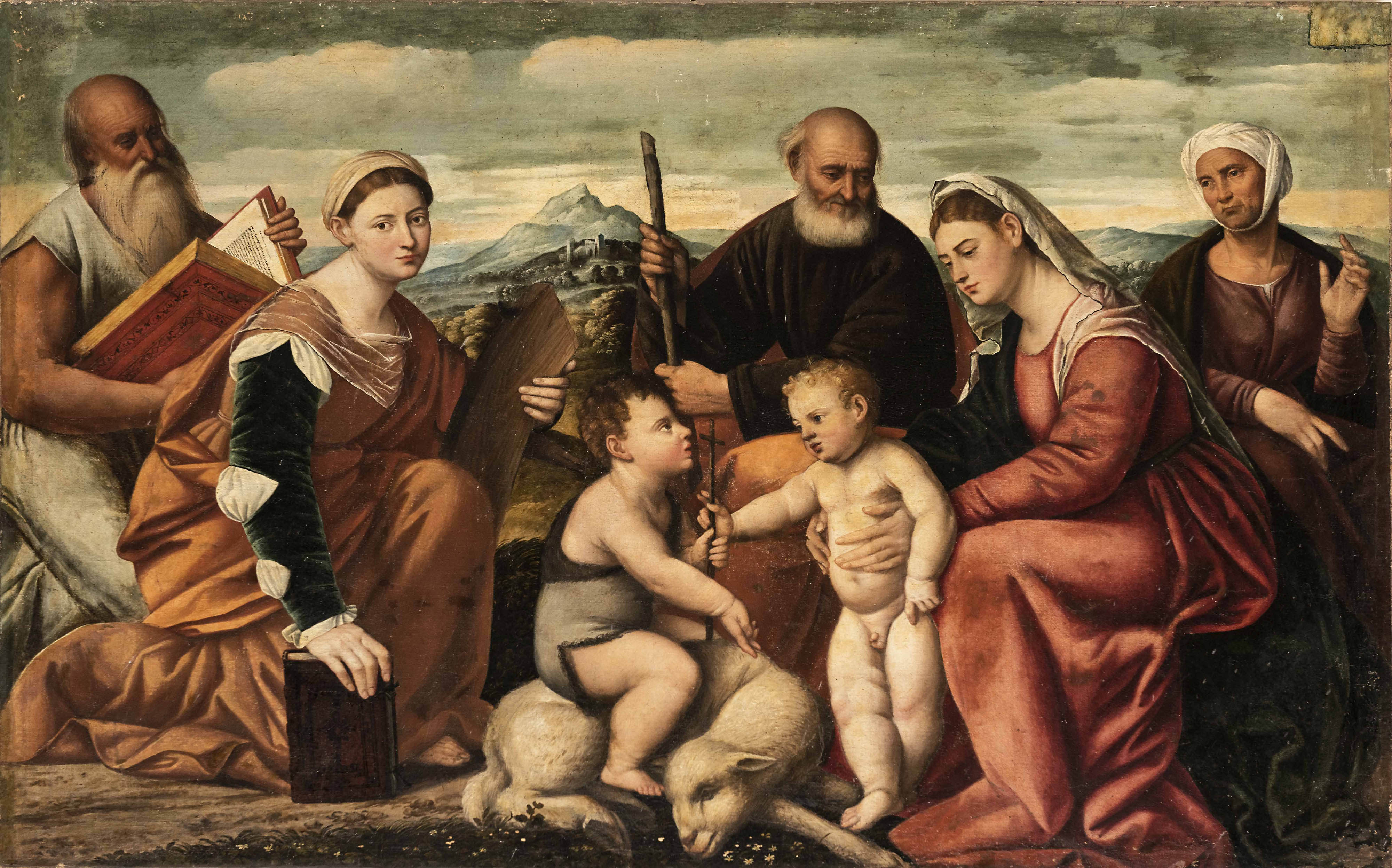
This Sacra Conversazione was a common theme among painters of the schools of Veneto and Lombardy. In this case, it was rendered with the elegance and sereneness typical of Bernardino Licinio’s style. From the left we see Jerome, Catherine of Alexandria, the young John the Baptist, Jesus, Joseph and the Virgin Mary. The natural character of the expressions of both Mary and Catherine have led critics to believe that these two faces are true portraits. By contrast, the figures of Jerome and Joseph show the influence of Tuscan and Roman models and suggest a dating of the work to roughly 1540.
Rome, Borghese Collection, 1693 (Inventory 1693, room VII, no. 24; Della Pergola 1955); Inventario Fidecommissario Borghese the palm branch 1833, p. 22. Purchased by Italian state, 1902.
Catalogue entry
In the 1693 inventory of the Borghese estate this painting, of unknown provenance, was documented as follows: “A large painting, the Madonna, the Child, Saint Joseph, the Infant Saint John riding a sheep, and three other figures holding books, on canvas, no. 318, in a gilded frame with carved decorations by Paolo Veronese.” At that time it was attributed to Paolo Caliari. This attribution was subsequently revised in 1833 by the compiler of the fideicommissari inventory, where the work was instead catalogued under “Venetian School.” In 1892, Morelli (1892; see also 1897) was the first to suggest the name of Bernardino Licinio, a proposal which was later widely accepted by scholars (Modigliani 1903; Longhi 1928; Venturi 1928; Della Pergola 1955; Vertova 1975; Herrmann Fiore 2006).
The composition, geometrically simple and perhaps somewhat rigid in comparison to the earlier Sacra Conversazione with Donor held in the Musée de Grenoble (inv. MG 23, signed and dated 1532; Momesso 2009, p. 58, no. XVI), displays the refined and restrained style typical of the Venetian painter. It corresponds to works Licinio produced around the 1540s, a period during which the artist, having moved away from the intense Titianesque influence of his earlier years, began to gravitate towards the contemporary Tusco-Roman tradition. This reorientation is particularly evident in the Mannerist depiction of the figure of Girolamo (see again Vertova 1975).
E. Modigliani, La cosiddetta “Famiglia di Bernardino Licinio” alla Galleria Borghese, in “L’Arte”, VI, 1903, p. 381;
R. Longhi, Precisioni nelle Gallerie Italiane, I, La R. Galleria Borghese, Roma 1928, p. 194;
A. Venturi, Storia dell'arte italiana, IX, La pittura del Cinquecento, Milano 1928, p. 482;
B. Berenson, Pitture Italiane del Rinascimento, Milano 1936, p. 243;
P. della Pergola, La Galleria Borghese. I Dipinti, I, Roma 1955, p. 116, n. 208;
B. Berenson, Italian Pictures of the Renaissance. VenetianSchool, London 1958, p. 98;
P. della Pergola, L’Inventario Borghese del 1693 (II), in “Arte Antica e Moderna”, XXVIII, 1964, p. 452;
L. Vertova, Licinio, Bernardino in I pittori bergamaschi dal XIII al XIX secolo, I, Il Cinquecento, Bergamo 1975, p. 430;
K. Herrmann Fiore, Galleria Borghese Roma scopre un tesoro. Dalla pinacoteca ai depositi un museo che non ha più segreti, San Giuliano Milanese 2006, p. 61.
For more information on rights and reproductions, visit our Photos and Videos section.