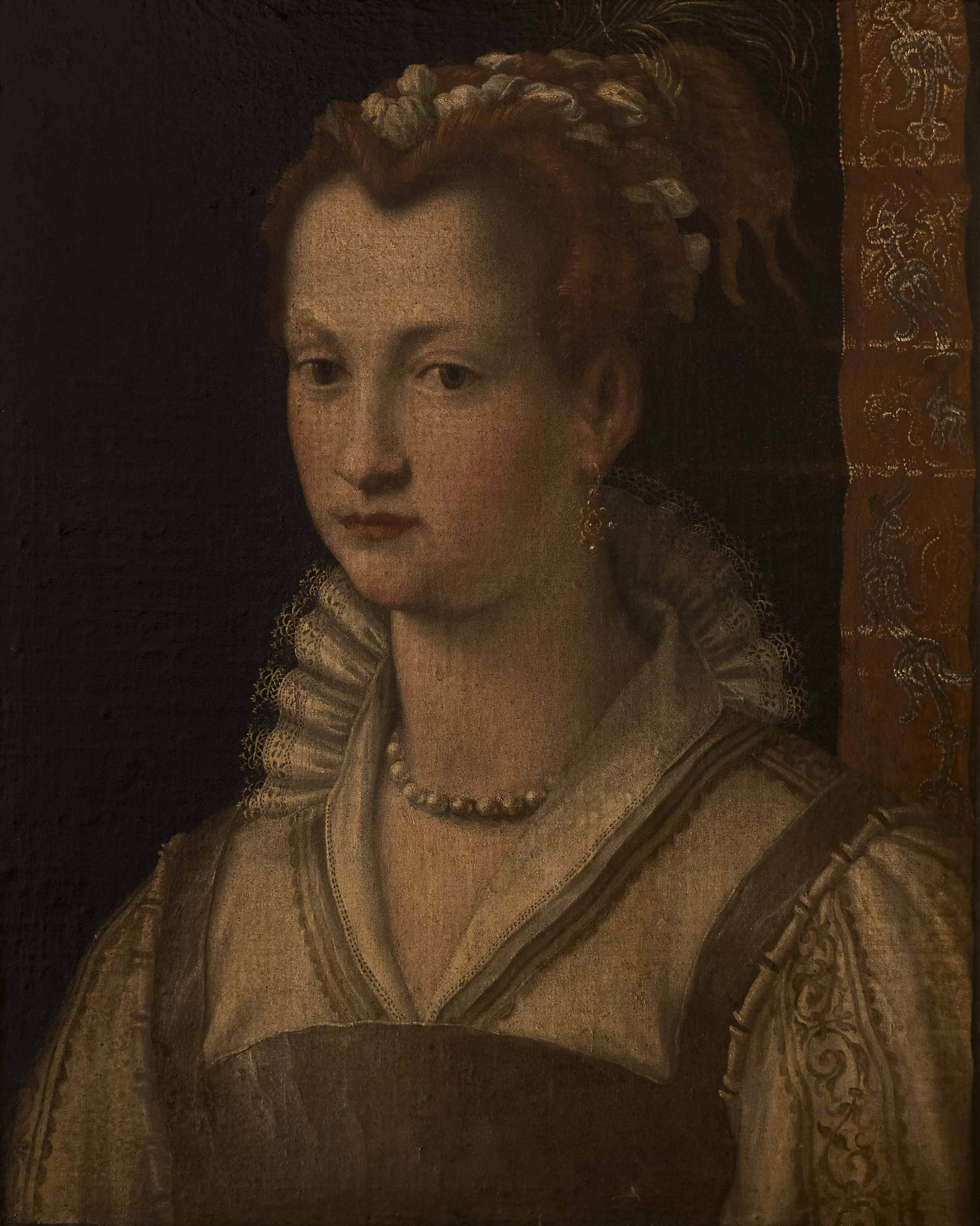
The painting is first documented as forming part of the Borghese Collection in 1693. Inventories initially labelled it as an anonymous work in the style of Bronzino; only later was the attribution made to the workshop of the Florentine painters Francesco and Giovanni Brina.
It portrays Leonor Alvarez di Toledo, niece of the Grand Duchess of Tuscany of the same name. Here she is depicted in a seated position, as is suggested by the apple which is barely visible behind her. She wears a refined blouse with an elegantly embroidered collar; her elaborate hairstyle is further embellished with feathered ribbons. The image is enriched by the red curtain with a damask border, the earring, and the pearl necklace – perhaps an allusion to the woman’s virtue.
(?) Rome, Borghese, Collection 1693 (Inventory 1693, room I, no. 23; Della Pergola 1964); Inventario Fidecommissario Borghese 1833, p. 40. Purchased by Italian state, 1902.
Conservation and Diagnostic
1952 - Augusto Cecconi Principi
Catalogue entry
The provenance of this painting remains unknown. No document attests to its presence in the Borghese household prior to 1693, when, according to Paola Della Pergola (BorgheseI, 1964), the work may be tentatively identified with the canvas listed in the first room of the Palazzo di Ripetta as “A painting with a head, a portrait of a Woman with an Antique-Style Collar, in a gilded frame, No. 18. Uncertain.” Admittedly, this description could equally apply to other similar portraits. Associated in 1833 with the “Manner of Titian”, it was not until 1892 that the painting was attributed to the Florentine painter Agnolo di Cosimo, known as Bronzino. This opinion was subsequently revised by Roberto Longhi (1928), who considered it to be a work from the school of Bronzino and was later entirely rejected by Paola Della Pergola (1955), who preferred to refer to it as the work of an “Unknown” seventeenth century artist. As noted by Federico Zeri (verbal communication, cited ibid.), a version of this painting is held in Montepulciano (Museo Civico Pinacoteca Crociani, inv. 73/1971; L. Martini, in Museo Civico Pinacoteca Crociani 2000, pp. 124–125, 201, no. 95). This work, in turn, derives from the full-length portrait in the Museo Stibbert in Florence, attributed to Francesco Brina (Langedijk 1981, p. 713). Brina, a pupil of Michele Tosini, is said to have depicted Eleonora di Garzia di Toledo (1553–1576), the young wife of Pietro de’ Medici, who was tragically murdered by her husband, on the occasion of their marriage in 1571(Bramanti 2007). This identification is supported by comparison with a small portrait on paper in the Kunsthistorisches Museum in Vienna, inscribed “LEONORA VXOR / DI PIERO MEDICE”, in which Eleonora is shown wearing the same dress. However, whereas Brina’s Florentine version includes nuptial iconographic elements, such as the small carnation, the Viennese portrait lacks them, leading Karla Langedijk to date the Stibbert version to the time of the marriage. In 1960, a copy with variations was recorded in a private Florentine collection and broadly attributed to the circle of Francesco Brina and his brother Giovanni, (s.a., in Mostra dei tesori 1960, p. 26, no. 49). It is plausible that the Borghese version may also be situated within the same artistic milieu.
R. Longhi, Precisioni nelle Gallerie Italiane, I, La R. Galleria Borghese, Roma 1928, p. 183;
P. della Pergola, La Galleria Borghese. I Dipinti, I, Roma 1955, p. 141, n. 250;
P. della Pergola, L’Inventario Borghese del 1693(I), in “Arte Antica e Moderna”, XXVI, 1964, p. 221;
L. Martini, Museo Civico Pinacoteca Crociani, Siena 2000, pp. 124-125, 201 n. 95;
K. Herrmann Fiore, Galleria Borghese Roma scopre un tesoro. Dalla pinacoteca ai depositi un museo che non ha più segreti, San Giuliano Milanese 2006, p. 30;
V. Bramanti, Breve vita di Leonora di Toledo (1555-1576), Firenze 2007.
For more information on rights and reproductions, visit our Photos and Videos section.