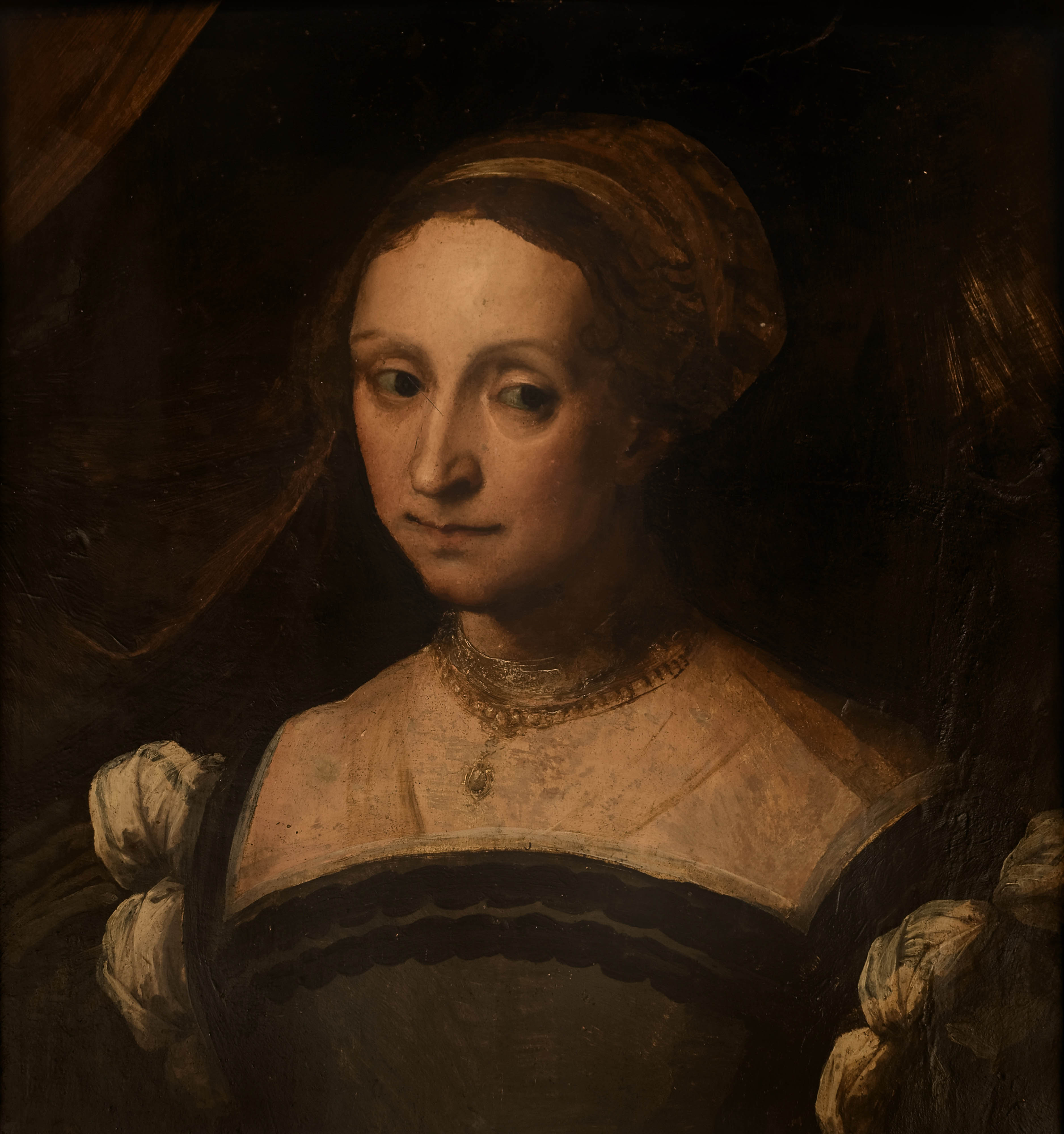
Attributed in the Inventario Fidecommissario to an unknown painter of the Veneto school, this panel forms part of a substantial group of works which in the past were all attributed to Giulio Romano. With the exception of the beautiful Madonna and Child withThe Infant Saint John the Baptist (inv. no. 374), today critics rather believe them to be products of Giulio’s flourishing workshop, most likely executed from cartoons by the master.
The identity of the lavishly dressed woman portrayed here is unknown. Her strongly defined features and the fixity of her gaze suggest that the artist, while not highly skilled as a painter, was certainly capable of profound introspection.
19th-century frame decorated with four corner palmettes, 73 x 70 x 8 cm
Provenance
Rome, Borghese Collection, 1833 (Inventario Fidecommissario Borghese 1833, p. 33). Purchased by Italian state, 1902.
Conservation and Diagnostic
1903/1905 - Luigi Bartolucci (pest control);
1936 - Augusto Cecconi Principi;
1953 - Alvaro Esposti.
Catalogue entry
The provenance of this painting remains unknown. The work was listed in both the Fideicommissario inventory of 1833 and in Giovanni Piancastelli’s catalogue (1891) as belonging to the “School of Paolo Veronese”. The portrait was subsequently attributed at various times to Dosso Dossi and Giulio Romano (see Della Pergola 1959). These attributions were later revised, respectively by Adolfo Venturi (1893) and Roberto Longhi (1928), who refrained from proposing alternative artists. Longhi ultimately opted instead for an anonymous Roman painter of the sixteenth century. Indeed, while Venturi noted that the painting “lacks the vigour of Dosso’s technique and his vivid colouring,” Longhi described it as “certainly of the Roman school of the Cinquecento, and by no means mediocre”.
In 1959, Paola Della Pergola published the painting as an autograph work by the artist. His opinion was possibly influenced by the oral opinion of Federico Zeri, who considered Giulio Romano a “fitting” attribution. Della Pergola assessed it as an unfinished work, particularly in regards to the background and drapery, yet firmly placed it within a milieu that was undoubtedly familiar to the creator of the panel, who was very likely connected to the flourishing workshop of the Roman master.
In 2006, Kristina Herrmann Fiore listed the work as “In the manner of Giulio Romano”.
R. Longhi, Precisioni nelle Gallerie Italiane, I, La R. Galleria Borghese, Roma 1928, p. 186;
P. della Pergola, La Galleria Borghese. I Dipinti, II, Roma 1959, p. 91, n. 128;
K. Herrmann Fiore, Galleria Borghese Roma scopre un tesoro. Dalla pinacoteca ai depositi un museo che non ha più segreti, San Giuliano Milanese 2006, p. 37.
For more information on rights and reproductions, visit our Photos and Videos section.