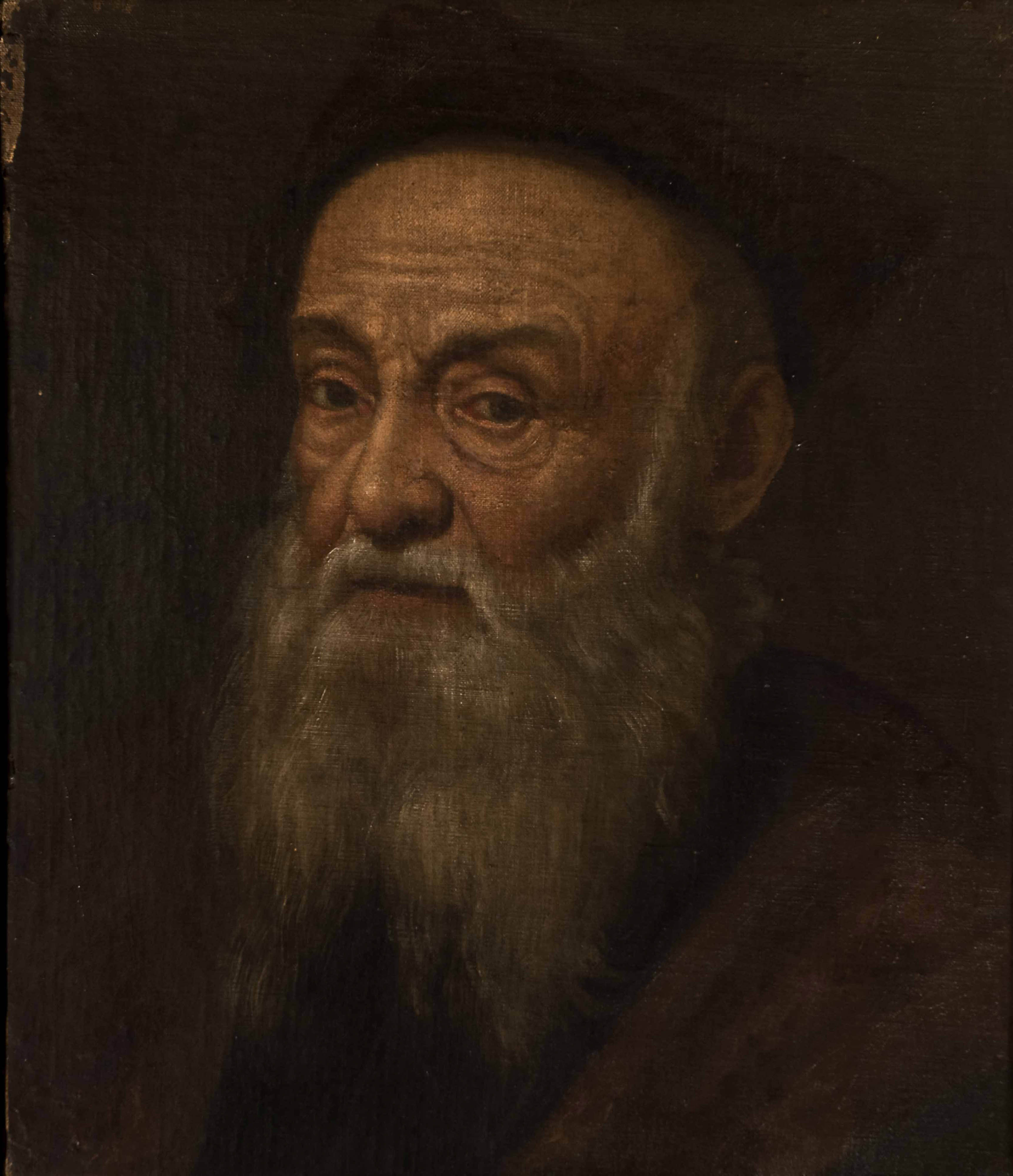
The painting is first listed in the Borghese inventory of 1790, where it is described as the ‘head of an old man’ by Scipione Pulzone; this attribution in fact supersedes an older one in favour of the German painter Johann Stephan von Calcar.
The subject portrayed here has been identified as Giovanni Ricci (1498-1574), a Sienese ecclesiastic who was nominated cardinal in 1551. Here he is shown in civilian clothing, with a black tricorn hat and a mantle with a fur collar.
Rome, Borghese Collection, 1790 (Inventory 1790, room IX, no. 49); Inventario Fidecommissario Borghese 1833, p. 37. Purchased by Italian state, 1902.
Conservation and Diagnostic
1952 - Augusto Cecconi Principi;
2002/03- Andrea Parri (frame).
Catalogue entry
The provenance of this painting is unknown. According to Paola Della Pergola (1959), the earliest known reference to the work dates to around 1790, when it was listed in the Borghese collection as “A Head of an Old Man, Scipione Gaetano.” By 1833, however, the portrait was described as being square in format, a detail inconsistent with the present canvas.
A similar description of “Head of an old man” by an unknown artist appears in the nineteenth century Fideicommissari inventory. Although this description could theoretically correspond to the work, the measurements recorded in the document are again inaccurate. Finally, the entry “Panel painting of a Head with a long beard and black cap,” which Della Pergola (1964) tentatively associated with the work, must also be excluded, as the noted support, a panel rather than canvas, precludes such an identification.
The artist's identity also remains uncertain. Giovanni Piancastelli (1891) listed the work under the name of Scipione Pulzone. In 1893, however, Adolfo Venturi attributed it to the Venetian school, remarking that the painting “Shows the manner of a follower of Titian and has considerable strength of character; but the oxidised pigment prevents a full appreciation of its beauty.” This judgement was subsequently echoed by Roberto Longhi (1928), who dismissed the canvas as a “mediocre and damaged painting, Tizianesque in intention.” Della Pergola (1959), partly drawing on an oral opinion by Federico Zeri, attributed the portrait to the Rhenish painter Jan Stephan van Calcar. Van Calcar was trained in Italy in Titian’s workshop and was later active in Naples, where he became acquinted with Giorgio Vasari. This attribution, however, has also proven weak: in 1992, Marta Ausserhofer determined the Borghese portrait to be stylistically divergent from van Calcar’s characteristic detached manner, consequently excluding it from his corpus.
As for the sitter’s identity, Paola Della Pergola cautiously suggested that the subject might be Giovanni Ricci (1498–1574), a prelate born in Chiusi to a family from Montepulciano. Appointed cardinal in 1551, Ricci was also known for his vineyard on the Pincian Hill, which, upon his death, passed to Cardinal Ferdinando de’ Medici. Della Pergola’s hypothesis was based on a comparison with a portrait by Pulzone, published by Zeri in 1957 (Fogg Art Museum, inv. 1934.66), which bears an identifying inscription. However, if this identification were correct, a significant chronological issue would arise. According to Della Pergola’s analysis, the portrait would have to predate Ricci’s elevation to the cardinalate, an assumption supported by the absence of ecclesiastical vestments in the painting and the date of his nomination, which postdates the artist’s death. Therefore, if van Calcar died by 1550, he could not have portrayed Ricci as an elderly man. This observation, together with the stylistic analysis advanced by Ausserhofer in 1992, therefore leaves the sitters identity unresolved.
R. Longhi, Precisioni nelle Gallerie Italiane, I, La R. Galleria Borghese, Roma 1928, p. 193;
P. della Pergola, La Galleria Borghese. I Dipinti, II, Roma 1959, pp. 157-158, n. 226;
M. Ausserhofer, Johann Stephan von Calcar. Das Poträt des Melchior von Brauweiler von 1540, Kleve 1992, p. 74;
K. Herrmann Fiore, Galleria Borghese Roma scopre un tesoro. Dalla pinacoteca ai depositi un museo che non ha più segreti, San Giuliano Milanese 2006, p. 56.
For more information on rights and reproductions, visit our Photos and Videos section.