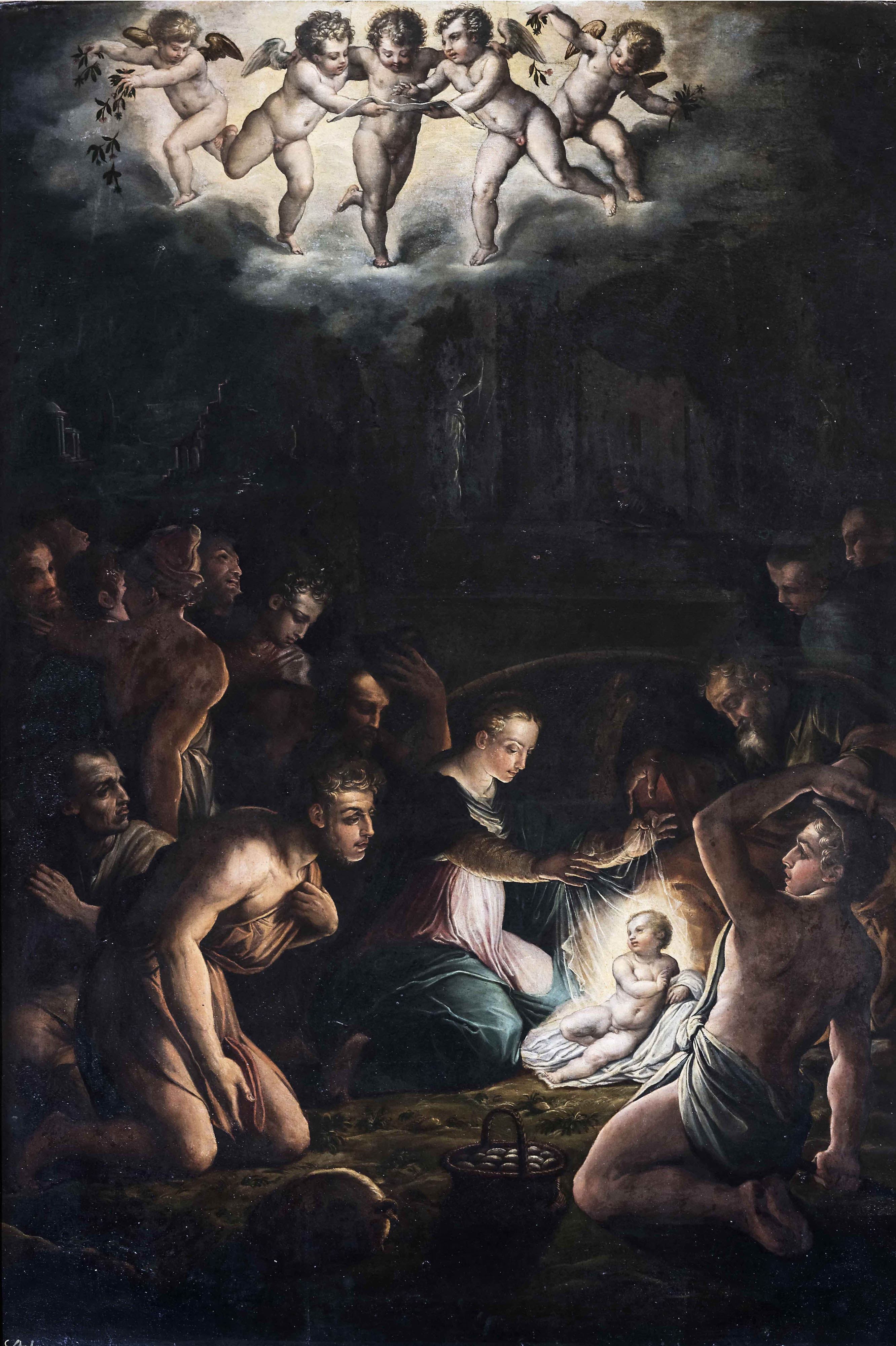
This panel was first documented as forming part of the Borghese Collection in 1650, when Iacomo Manilli described it as a work by Giorgio Vasari. This is probably the same Nativity mentioned by the artist in his autobiography, which some critics believe to be the version from Cardinal Salviati’s collection, while others identify it with the work held by Pierantonio Bandini. Whatever its actual provenance, it is certain that the painting was warmly received by Vasari’s contemporaries, admired for its high stylistic quality and the lighting effects.
Rome, Borghese Collection, 1650 (Manilli 1650; Della Pergola 1959); Inventory 1693, room IX, no. 27; Inventario Fidecommissario Borghese 1833, p. 16. Purchased by Italian state, 1902.
Conservation and Diagnostic
1903 Luigi Bartolucci (Restoration)
1907 Luigi Bartolucci (Restoration)
1951 Augusto Cecconi Principi (Restoration)
1963 Alvaro Esposti (Restoration)
Catalogue entry
The provenance of this painting remains uncertain. Despite its inclusion in the Borghese collection from 1650 onwards, when Manilli mentioned it in the Casino at Porta Pinciana and attributed it to Giorgio Vasari, its earlier history remains elusive. The hypothesis proposed by Paola Della Pergola (1959), identifying it among the possessions of Olimpia Aldobrandini the Younger listed in 1682, appears to be unlikely. The description of the work in the noblewoman’s inventory refers to a depiction of Christ “playing on the ground on straw” (Della Pergola, Aldobrandini 1963, p. 80, no. 409), which diverges significantly from the present composition.
Despite Manilli’s account, the painting’s authorship has been a subject of debate from early on. By 1693, it was already recorded as of uncertain hand and, later, in the fideicommissari inventory of 1833, it was attributed to the Dutch painter Gerrit van Honthorst, an attribution also proposed by Adolfo Venturi (1893), who linked it to the artist’s circle.
The rediscovery of Vasari’s authorship was due to Voss (1913; later corroborated by Rud 1964 and Bénézit ed. 1976), who was the first to attribute the panel to the Aretine master. He connected it to the painting of the same subject executed by Vasari for Pierantonio Bandini, a work referenced by Vasari himself in the Vite [Lives] (1568): “and for Pierantonio Bandini [I painted] a Nativity of Christ, with the light of night and with varied invention.” According to this hypothesis, the painting was executed in Rome in 1553, a view and dating that was accepted by Roberto Longhi (1928), Adolfo Venturi (1933), and Paola Della Pergola (1959). However, a different interpretation was advanced by Paola Barocchi in 1964. In light of Wolfgang Stechow’s (1939) earlier proposition, she rejected the attribution to Bandini and instead identified the Borghese composition as the “Nativity… painted by night” commissioned by Cardinal Salviati and executed by Vasari around 1546. This interpretation was subsequently reiterated by Laura Corti (1989), who made reference to a drawing (Louvre, Cabinet des Dessins, inv. 2084) and a potential workshop replica (Uffizi, inv. 1855). Nevertheless, this hypothesis has not been further explored in subsequent scholarship.
G. Vasari, Vite de’ più eccellenti architetti, pittori, et scultori italiani, da Cimabue a’tempi nostri, Firenze 1550, ed. a cura G. Milanesi, VII, Firenze 1881, p. 695;
H. Voss, Über einige Gemälde irnd Zeichnungen von Meistern aus dem Kreise Michelangelos, in “Jahrbuch der Königlich. Preussischen Kunstsammlungen”, XXXIV, 1913, pp. 306, 313;
H. Voss, Die Molerei der Spätrenaissance in Rom und Florenz, I, Berlin 1920, p. 278;
R. Longhi, Precisioni nelle Gallerie Italiane, I, La R. Galleria Borghese, Roma 1928, p. 201;
P. della Pergola, La Galleria Borghese in Roma, Roma 1951, p. 22;
P. della Pergola, La Galleria Borghese. I Dipinti, II, Roma 1959, p. 57, n. 83;
P. della Pergola, Gli Inventari Salviati, in “Arte antica e moderna”, X, 1960, pp. 197-198;
P. Barocchi, Vasari pittore, Firenze 1964, p. 30;
E. Rud, Giorgio Vasari Vater des europaischen Kunstgeschichte, Stuttgart 1964, p. 57;
E. Bénezit, Dictionaire critique et documentaire des peintres, sculpteurs, dessinateurs et graveurs, Paris 1976, p. 404;
L. Corti, Vasari. Catalogo completo dei dipinti, Firenze 1989, p. 67;
C. Stefani, in P. Moreno, C. Stefani, Galleria Borghese, Milano 2000, p. 344;
K. Herrmann Fiore, Galleria Borghese Roma scopre un tesoro. Dalla pinacoteca ai depositi un museo che non ha più segreti, San Giuliano Milanese 2006, p. 91.
For more information on rights and reproductions, visit our Photos and Videos section.