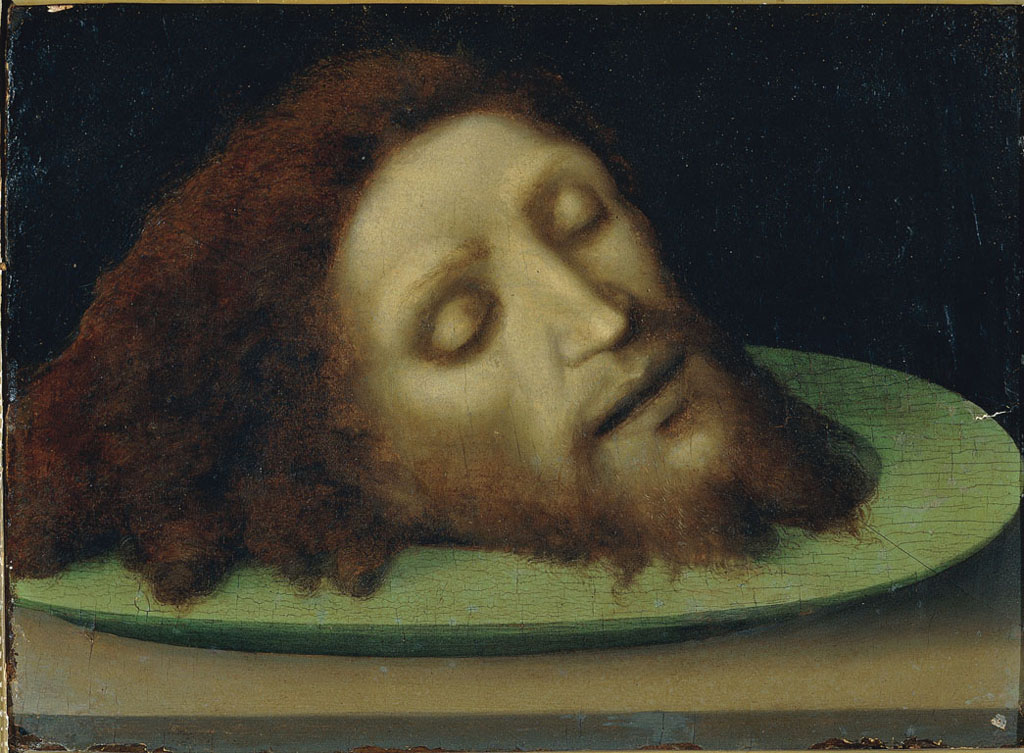
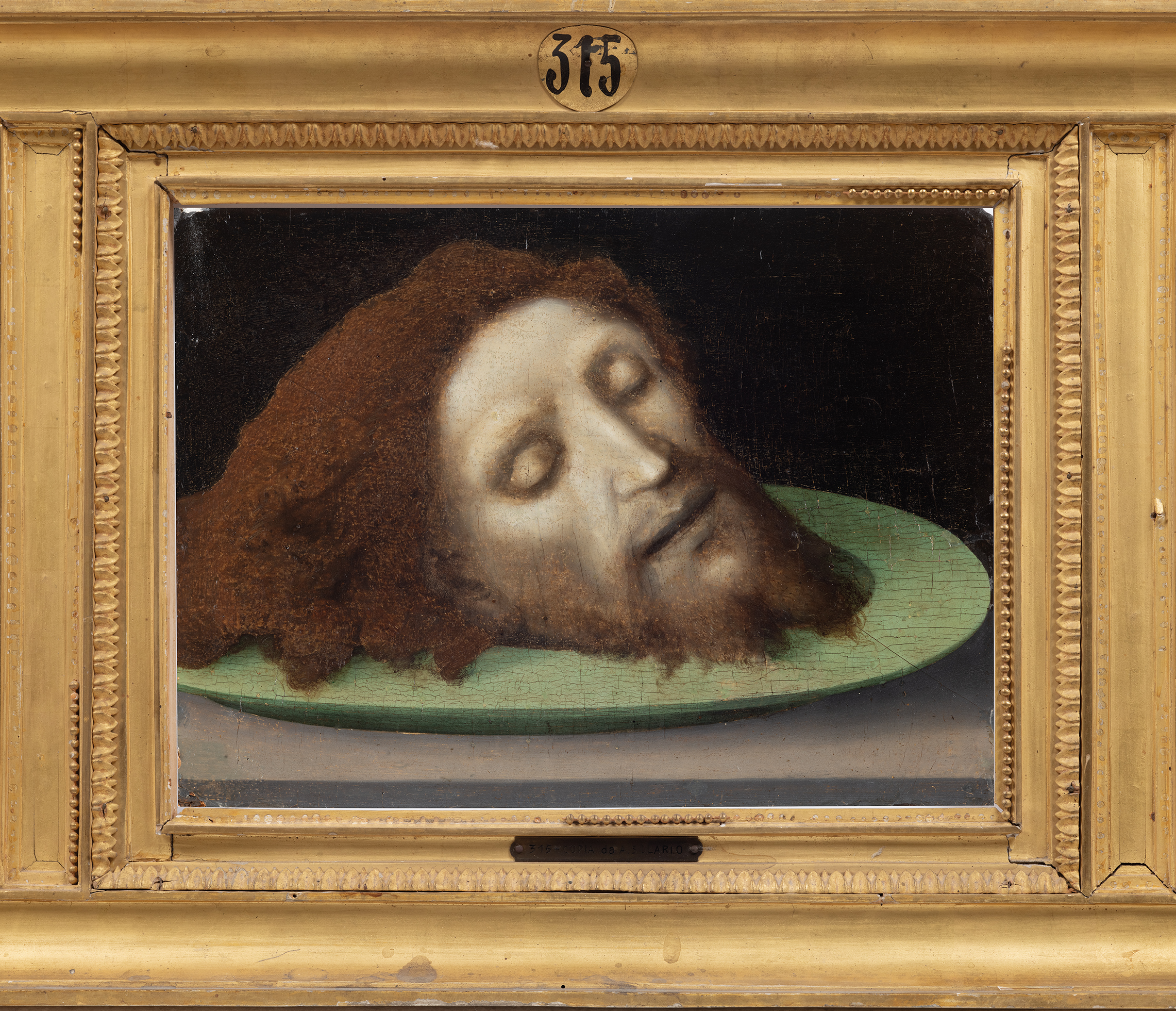
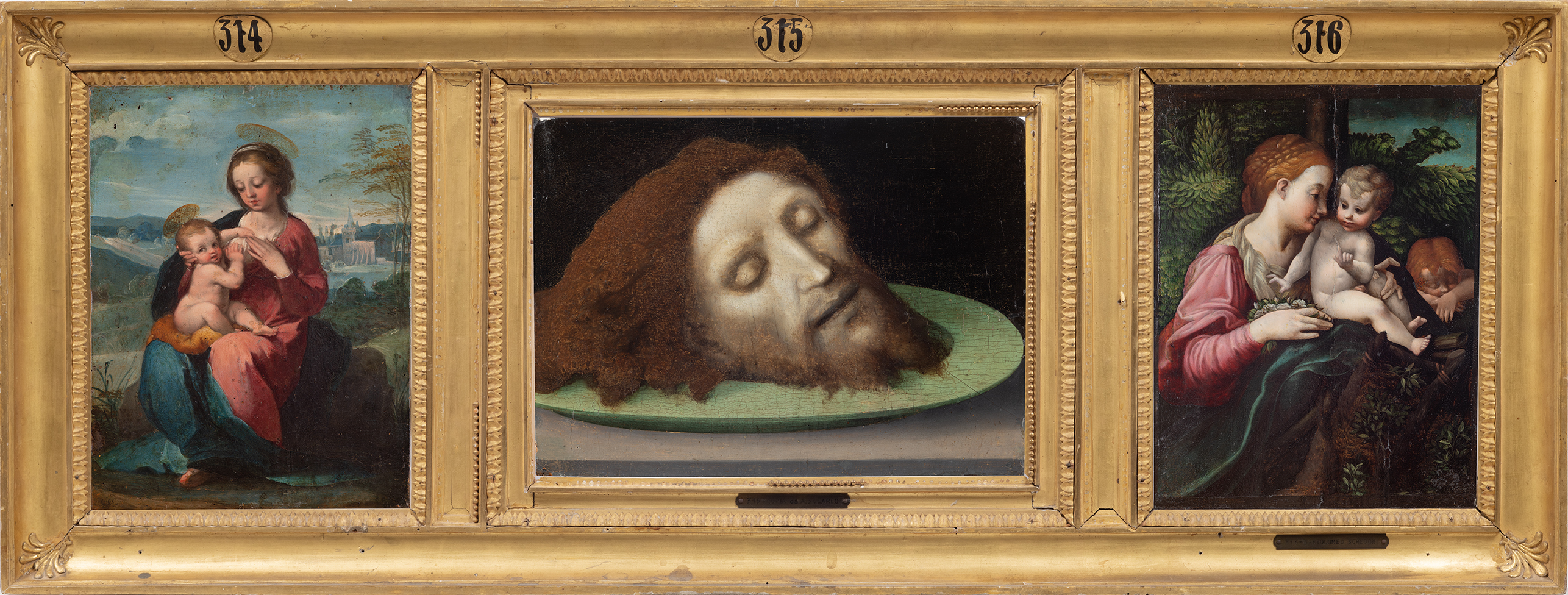
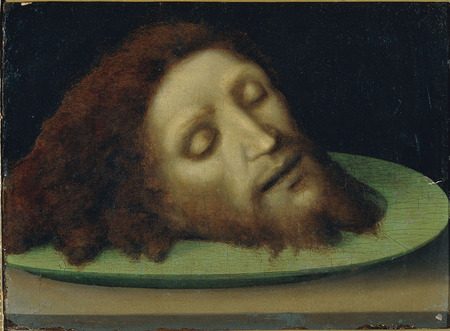
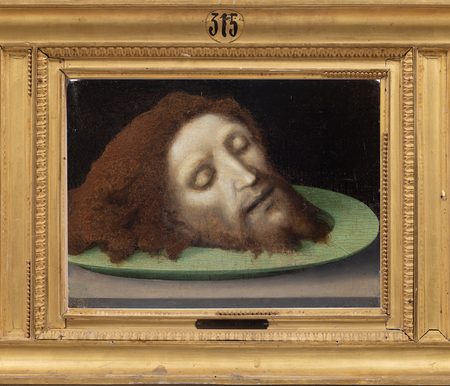
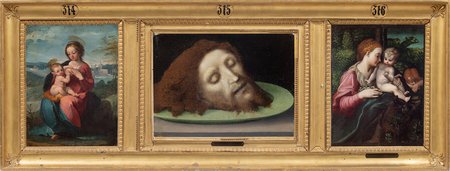
The panel, mentioned in the Borghese collection in an inventory dated 1700, is one of the countless variations of the celebrated Head of John the Baptist by Andrea Solario. This painting, made in Milan, was brought across the Alps by the Lombard artist and used as a devotional image by King Louis XII who, seriously ill, requested it from his advisor Cardinal Georges d’Amboise, with whom Solario was staying. The painting depicts the severed head of the young ascetic, presented by Salome to the cruel Herod on a silver platter. This image, besides inspiring compassion and emotion in the faithful, testifies to the iconographic fortune of this subject in mid-16th-century Milan.
Rome, Borghese Collection, 1700 (Inventory 1700, St. III, no. 22; Della Pergola 1955); Inventory 1790, St. X, no. 60; Inventario Fidecommissario Borghese 1833, p. 23; Italian State Purchase, 1902.
Exhibitions
1984 - Roma, Palazzo Barberini (Leonardo e il leonardismo a Roma)
Conservation and Diagnostic
1903 Luigi Bartolucci (Restoration)
1903-1905 Luigi Bartolucci (Restoration)
1953 Gilda Diotallevi (Restoration)
2015-2016 Laboratorio di restauro Palazzo Barberini; Roberto Saccuman (supporto) (Restoration)
Catalogue entry
This panel, of unknown provenance, has been documented in the inventory of the Borghese collection since around 1700, when it was attributed to Titian. As suggested by Paola Della Pergola in 1963, the work is likely to be identified with the “painting with the head of Saint John above a dish” listed among the possessions of Olimpia Aldobrandini the Younger in 1682.
Wiecker, citing Ramdohr (1787, I, p. 309) in reference to a Head of Saint John the Baptist by Bellini, proposed a different identification. According to his view, the painting in question corresponds to number 423 of the same inventory, described as: “A panel painting with the head of Saint John the Baptist inside a dish, approximately one and a half palms high, in a gilded frame, with a label stating Gio: Bellino, as in the inventory on folio 190 no. 25 and in that of His Eminence the Cardinal, no. 572”. Although the dimensions do match those of the Borghese version, Della Pergola’s identification seems more plausible, as the head is described as being “above” rather than “inside” the dish.
The panel was later attributed to Raphael and to his school, respectively around 1790 and in the fideicommissari inventories of 1833. Initially considered a work of the Venetian school (Venturi 1893), it was subsequently reassigned to the Lombard sphere (Longhi 1928). In 1955, Paola Della Pergola advanced a new hypothesis, suggesting that the painting belongs to the numerous variants derived from a lost original by Leonardo da Vinci, echoed in a drawing by Andrea Solario now in the Louvre (DAG, inv. 2570).
Conversely, Angela Ottino Della Chiesa (1956) proposed that the Borghese panel may reflect the model of an otherwise unknown painting by Bernardino Luini, a name previously suggested by Roberto Longhi in an oral communication cited by Della Pergola.
R. Longhi, Precisioni nelle Gallerie Italiane, I, La R. Galleria Borghese, Roma 1928, p. 207;
P. della Pergola, La Galleria Borghese. I Dipinti, I, Roma 1955, pp. 84-85, n. 151;
A. Ottino Della Chiesa, Bernardino Luini, Novara 1956, p. 134;
P. Della Pergola, Gli Inventari Aldobrandini: l’Inventario del 1682 (III), in “Arte Antica e Moderna”, XXII, 1963, pp. 175-191, p. 177;
D. A. Browm, Andrea Solario, Milano 1987, p. 161;
A. Vezzosi, Presenze di Leonardo e del leonardismo a Roma, in Leonardo e il leonardismo a Napoli e a Roma, catalogo della mostra (Napoli 1983, Roma 1983), a cura di A. Vezzosi, Firenze 1983, p. 213, n. 475;
K. Herrmann Fiore, Galleria Borghese Roma scopre un tesoro. Dalla pinacoteca ai depositi un museo che non ha più segreti, San Giuliano Milanese 2006, p. 104.
For more information on rights and reproductions, visit our Photos and Videos section.