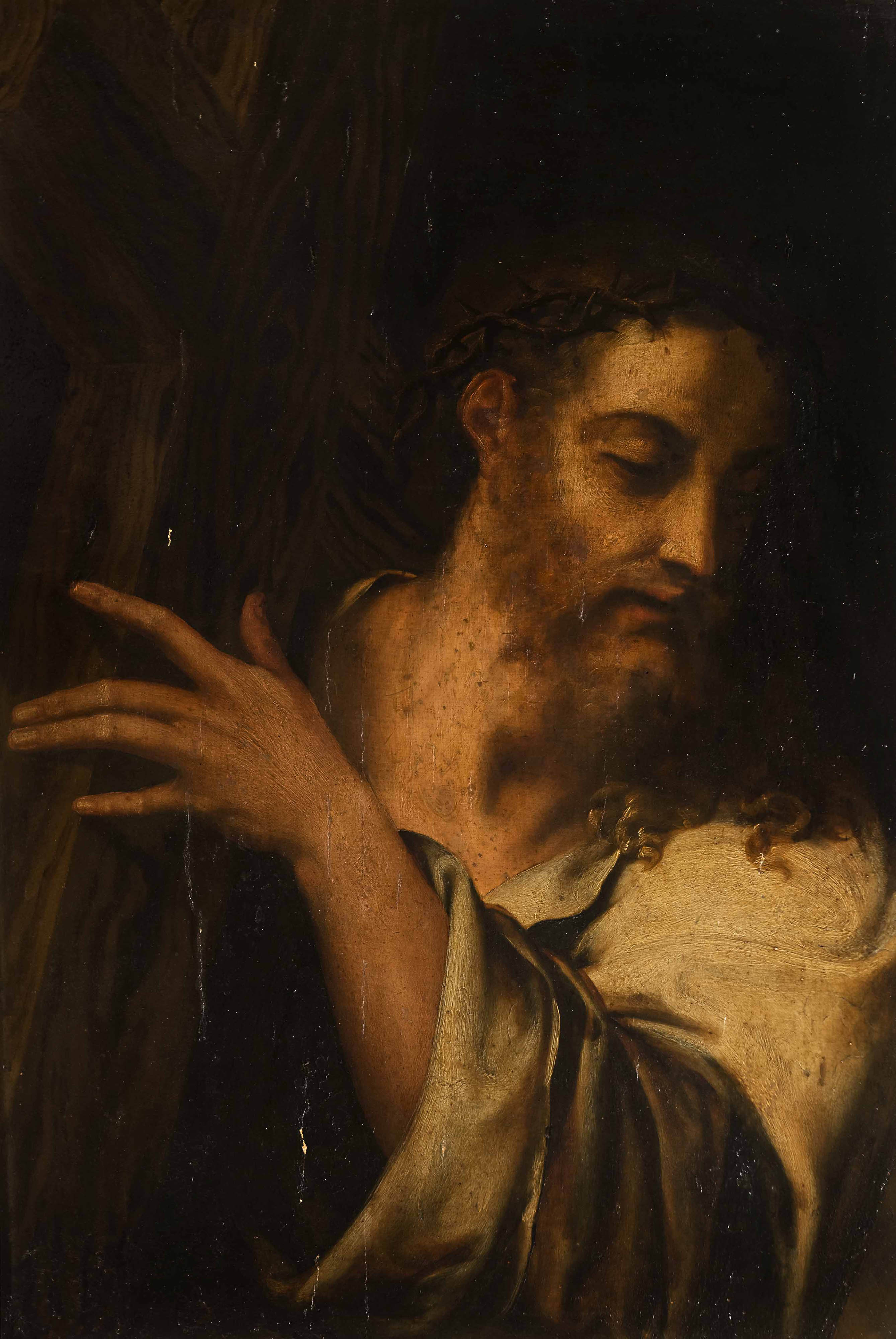
This Christ Carrying the Cross is a copy after Sebastiano del Piombo. It entered the Borghese Collection through the substantial inheritance of Pietro Aldobrandini and is listed in the 1626 inventory of the estate of Olimpia Aldobrandini the Elder. This panel, of quite good quality, is a partial replica of the well-known composition by the Venetian painter, of which numerous versions were made. In this case, the isolated figure of Christ emerges from the dark background as he drags the cross to Golgotha. The close-up perspective, together with the use of dark colours seems to infuse the scene with greater pathos, rendering it more effective from the devotional point of view.
Rome, collection of Olimpia Aldobrandini senior, 1626 (Inventory 1626, no. 83, no. 5; Della Pergola 1959); Inventory 1682; Rome, Borghese Collection, 1790 (Inventory 1790, room IX, no. 26 (De Rinaldis 1937); Inventario Fidecommissario Borghese 1833, p. 17. Purchased by Italian state, 1902.
Conservation and Diagnostic
1903 Luigi Bartolucci (Restoration)
1903-1905 Luigi Bartolucci (Restoration)
1952 Augusto Cecconi Principi (Restoration)
1985 Laboratorio di restauro Palazzo Barberini (Paola Sannucci) (Restoration)
2000 Laura Ferretti (Restoration)
Catalogue entry
This panel entered the collection through the substantial inheritance of Pietro Aldobrandini and is listed in the 1626 inventory of the estate of Olimpia Aldobrandini the Elder as “A painting of Christ Carrying the Cross by Giulio Romano, no. 4.” It later appears in the collection of Olimpia Aldobrandini the Younger as “A panel painting of Christ Carrying the Cross by Giulio Romano, three palms high, in a gilt and decorated frame…” The work was not recorded among the paintings held at the Palazzo in Campo Marzio in 1693 and is only mentioned again in 1790, at which time it was attributed to the “School of Michelangelo.” This attribution was taken over in the nineteenth century Fideicommissario records and noted in the manuscript entries compiled by Giovanni Piancastelli (1891).
In 1893, Adolfo Venturi proposed an attribution to “Licinio (School of Giovanni Antonio), known as Pordenone.” This suggestion was later dismissed by both Giulio Cantalamessa (1912), who deemed it the work of an anonymous “weak painter,” and by Roberto Longhi (1928), who considered it the product of an “Italian hand, not dissimilar to that of Marco Pino,” and suggested that its prototype may have been a work by Sebastiano del Piombo.
In 1959, Paola Della Pergola, following Longhi’s argumentation, published the painting as a partial copy after Sebastiano del Piombo, executed by an unknown painter not later than the first half of the sixteenth century. This attribution was subsequently refined by Mauro Lucco (oral communication in Sassu 2000) and Giovanni Sassu (2000), followed by Kristina Herrmann Fiore (2006), who all identified the artist as Prospero Fontana. This attribution, however, was recently rejected by Giulia Daniele (2022), who, in her catalogue raisonné of Fontana’s works, excluded the painting on the grounds that no other youthful work by the Bolognese painter show any engagement with Venetian art. She also noted the stylistic disparity between this painting, characterised by a dark background and heightened dramatic intensity, and Fontana’s known production. According to Daniele, the painting should rather be considered the work of an anonymous Roman or Florentine artist. Alternatively, the attribution to artist Marco Pino could be reconsidered, a hypothesis revived by Pier Luigi Leone de Castris in 1996 but later rejected by Andrea Zezza in 2003.
What is certain is, that the popularity of this subject, further amplified by several versions painted by Sebastiano Luciani himself from the 1530s onwards (Madrid, Museo del Prado, inv. P000348; inv. P000345; St Petersburg, Hermitage, inv. ГЭ-77; Budapest, Szépművészeti Múzeum, inv. 77.1; see Lucco 1980, pp. 117 no. 76, 122 no. 93, 124 no. 98 respectively), prompted numerous artists to produce copies. These works became particularly appreciated and widely sought after from the second half of the sixteenth century onwards. In the wake of the Council of Trent, the Church encouraged painters to produce works faithful to the Gospel, including narrative images like this Christ, capable of arousing piety and devotion in the faithful.
G. Cantalamessa, Note manoscritte al Catalogo di A. Venturi del 1893, Arch. Gall. Borghese, 1911-1912, n. 135;
R. Longhi, Precisioni nelle Gallerie Italiane, I, La R. Galleria Borghese, Roma 1928, p. 190;
A. De Rinaldis, La Galleria Borghese in Roma, Roma 1937, p. 227;
P. della Pergola, La Galleria Borghese. I Dipinti, II, Roma 1959, p. 137, n. 189;
P. Della Pergola, Gli Inventari Aldobrandini: l’Inventario del 1682, I, “Arte Antica e Moderna”, XIX, 1962, p. 322;
C. Volpe, M. Lucco, L'opera completa di Sebastiano del Piombo, Milano 1980, ad indicem;
P. Leone de Castris, Pittura del Cinquecento a Napoli: 1540-1573. Fasto e devozione, Napoli 1996, pp. 193, 203, 224-229 nota 14;
G. Sassu, Riconsiderazioni sull’attività di Prospero Fontana tra il 1539 ed il 1545, in “Proporzioni. Annali della Fondazione Roberto Longhi”, I, 2000, pp. 96-97, nota 74;
A. Zezza, Marco Pino. L'opera completa, Napoli 2003, p. 333 E.44;
K. Herrmann Fiore, Galleria Borghese Roma scopre un tesoro. Dalla pinacoteca ai depositi un museo che non ha più segreti, San Giuliano Milanese 2006, p. 48.
G. Daniele, Prospero Fontana "pictor bononiensis" (1509-1597). Catalogo ragionato dei dipinti, Roma 2022, p. 206 R38.
For more information on rights and reproductions, visit our Photos and Videos section.