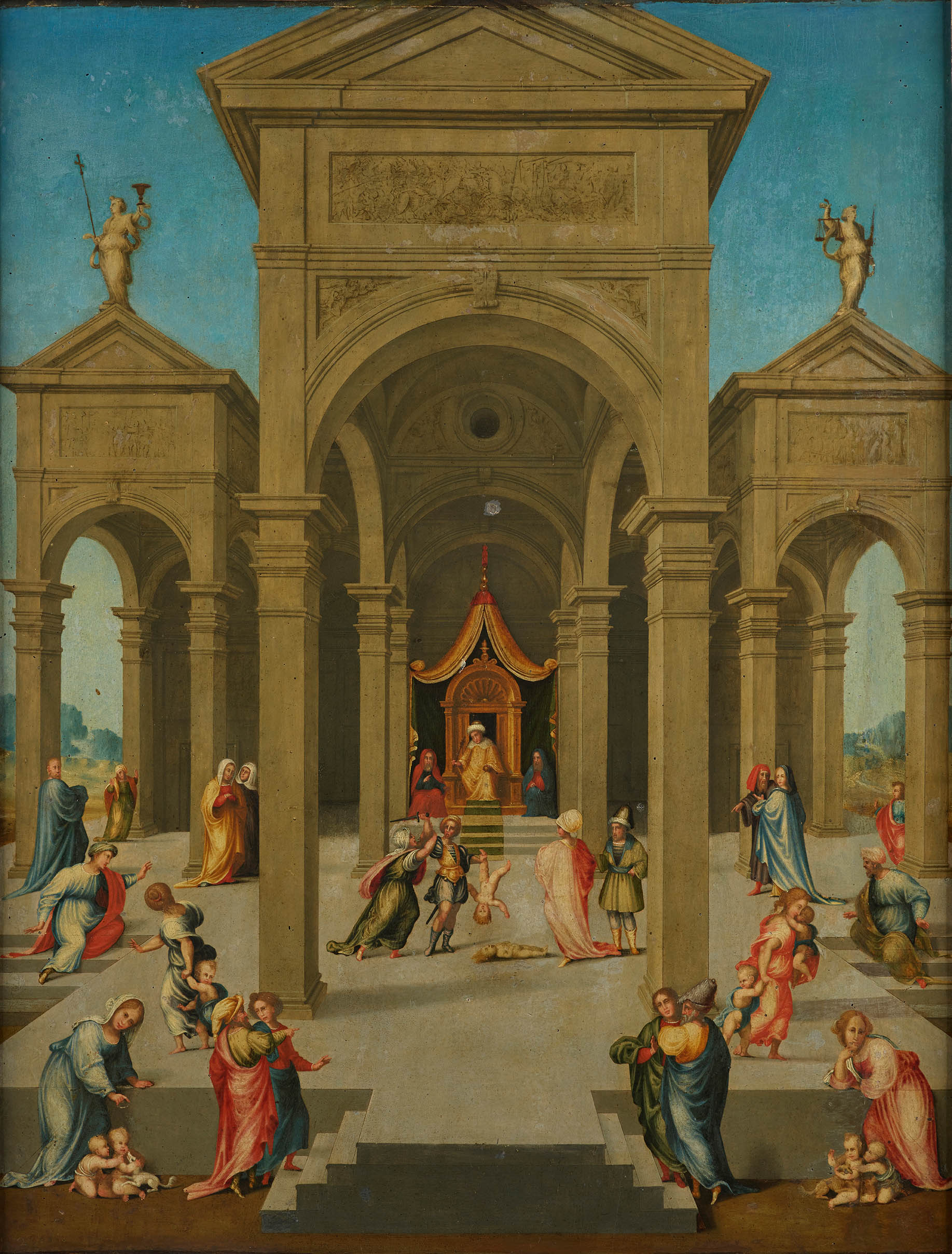
The scene, with its rigorously symmetrical structure, depicts the mythical King Solomon, celebrated in the Bible for his proverbial wisdom. The sovereign, seated on a throne under a canopy, is summoned by two women, who after giving birth to their children – one of whom has died – appealed to the courts to claim the maternity of the one newborn child who is still alive. Not knowing the reality of the facts, the old king cleverly provokes the two mothers, deciding to have the little body of the surviving child equally divided into two parts. At this request, the true mother, moved by sincere love, renounced her right to the child by stopping the armed royal guard, unlike the other woman who, envious, had accepted decision, thus revealing her wicked plan.
Sixteenth-century frame with arabesques on black background (cm 84 x 67 x 5.5)
Provenance
Rome, Borghese Collection, 1790 (Inventory 1790, St. VII, no. 21); Inventario Fidecommissario Borghese 1833, p. 28, no. 41. Purchased by the Italian State 1902.
Conservation and Diagnostic
1903/05 - Luigi Bartolucci (pest control)
1947 - Carlo Matteucci
1968 - Oddo Verdinelli
2002/03 - Andrea Parri (frame).
Catalogue entry
The provenance of this work remains unknown. The painting is first documented in the Borghese collection around 1790, when it was catalogued as a work by Franciabigio. The attribution was confirmed in the fideicommissari inventories of 1833, but later rejected by Giovanni Morelli, who in 1890 proposed the name of Piero di Cosimo. This view was subsequently accepted by part of the scholarly community (Knapp 1899; Berenson 1903; Lafenestre & Richtenberger 1905; T. Borenius in Crowe and Cavalcaselle ed. 1914). A different stance was taken by Adolfo Venturi, who in 1893 expressed concerns regarding the quality of the work, asserting that it appeared to be a perspective study rather than a fully realised painting. Nonetheless, despite these misgivings, he initially attributed the panel to Piero di Cosimo, only to revise his opinion in 1911, asserting that the painting “is not by Piero, but by one of his assistants.”
Taking up these observations, Ullmann (1894, 1896) endorsed Venturi’s view regarding the dominance of architectural elements and the stiffness of the figures, proposing the excistence of a workshop or school associated with Piero di Cosimo. De Rinaldis (1935) also spoke of a follower or assistant “rigorously engaged in applications of architectural perspective and figurative symmetry.” Later, in 1937, he proposed that the work came from the master’s workshop, a view shared by Douglas (1946), who suggested it was executed from a design by Piero di Cosimo.
The attribution to the Florentine master was later rejected by several scholars, including Roberto Longhi (1928) and Luigi Bacci (1966, 1976). Federico Zeri (verbal communication, cited in Della Pergola 1959), comparing the Borghese painting with the Death of Laocoön by Pier Francesco Foschi, attributed the Judgement of Solomon to the latter. He argued, that both paintings, derived from the now-destroyed frescoes by Filippino Lippi at Poggio a Caiano. This hypothesis, promptly taken up by Paola Della Pergola (1959), was later reconsidered by Zeri himself, who in 1962 proposed attributing the painting to the anonymous Master of Serumido, whom he identified as Aristotele da Sangallo, a figure active in Florence in the first half of the sixteenth century.
This proposal was endorsed by Silvia Meloni Trkulja (in Il primato del disegno, 1980) and Serena Padovani (2005), who chronolgically placed the Borghese panel at the turn of the second decade of the sixteenth century. However, this attribution has not been confirmed by Kristina Herrmann Fiore, who in 2006, published the work once again under the attribution to Foschi.
B. Berenson, Florentine Painters, New York 1909, p. 165;
J. A. Crowe, G. B. Cavalcaselle, A History of Painting in Italy, a cura di Borenius, VI, London 1914, p. 48;
R. Longhi, Precisioni nelle Gallerie Italiane, I, La R. Galleria Borghese, Roma 1928, p. 208;
B. Berenson, Pitture Italiane del Rinascimento, Milano 1936, p. 390;
A. De Rinaldis, La Galleria Borghese in Roma, Roma 1937, p. 227;
R. Langton-Douglas, Piero di Cosimo, Chicago 1946, pp. 79, 118;
A. De Rinaldis, Catalogo della Galleria Borghese, Roma 1948, p. 36;
P. della Pergola, La Galleria Borghese in Roma, Roma 1951, p. 26;
P. Morselli, Ragioni di un pittore fiorentino. Piero di Cosimo, in “L’Arte”, XXII, 1958, pp. 38, nota 67, 56, 83;
P. della Pergola, La Galleria Borghese. I Dipinti, II, Roma 1959, pp. 24-25, n. 25;
F. Zeri, Eccentrici Fiorentini, in “Bollettino d’Arte”, XLVII, 1962, p. 322;
M. Bacci, L’Opera completa di Piero di Cosimo, Milano 1966, pp. 105, 109, 127;
S. McKillop, Franciabigio Berkeley 1974, p. 210;
M. Bacci, L’Opera completa di Piero di Cosimo, Milano 1976, p. 99;
S. Meloni Trkulja, in Il primato del disegno, catalogo della mostra (Firenze, Palazzo Strozzi, 1980), a cura di C. Beltramo Ceppi, Firenze 1980, p. 139;
P. Moreno, C. Stefani, Galleria Borghese, Milano 2000, p. 243;
S. Padovani, I ritratti Doni. Raffaello e il suo "eccentrico" amico, il Maestro di Serumido, in "Paragone.Arte", LVI, 2005, pp. 15-16;
K. Herrmann Fiore, Galleria Borghese Roma scopre un tesoro. Dalla pinacoteca ai depositi un museo che non ha più segreti, San Giuliano Milanese 2006, p. 109.
For more information on rights and reproductions, visit our Photos and Videos section.