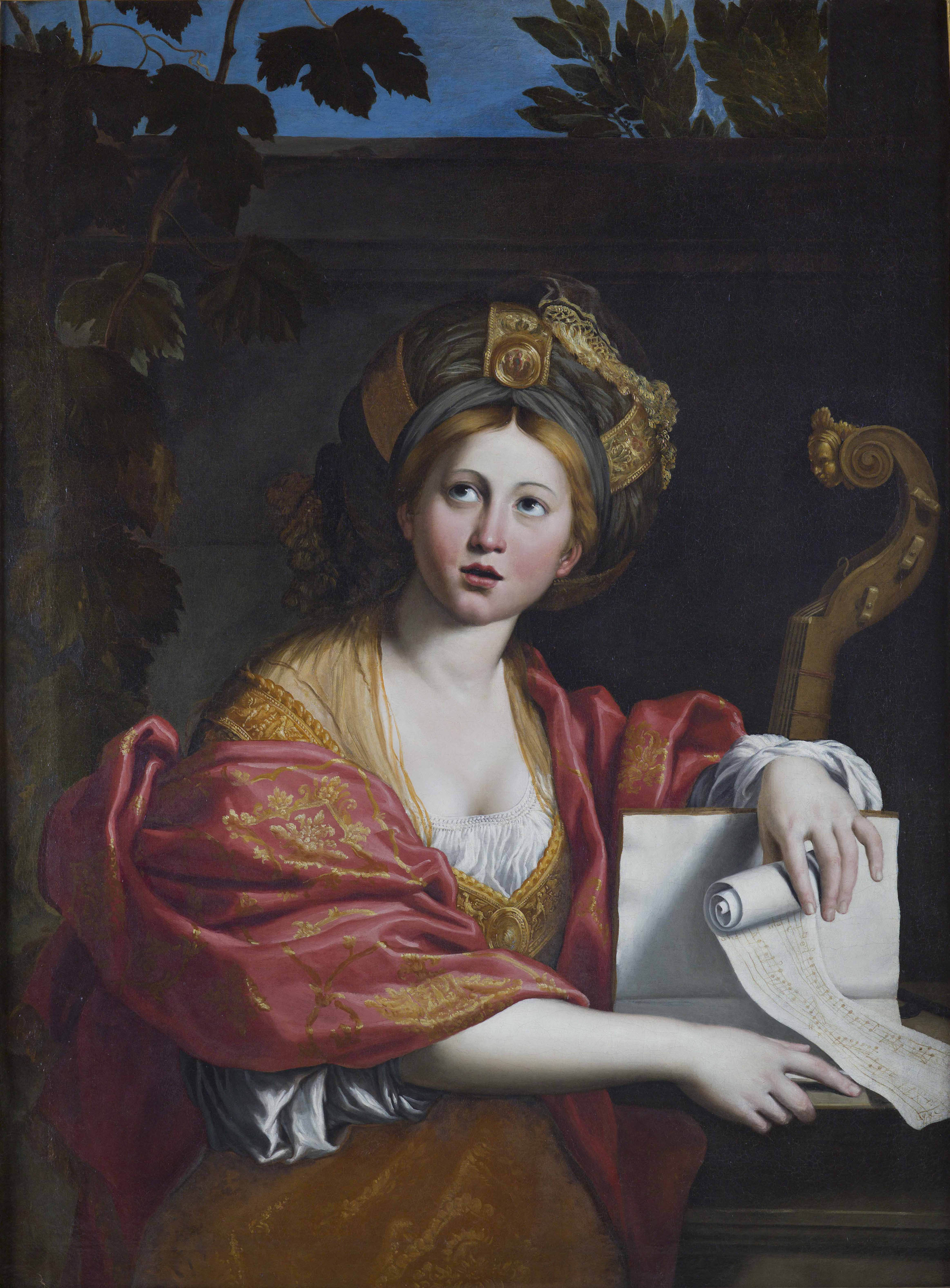
This canvas depicts a Sibyl, according to an unusual iconography, as this subject is generally portrayed without musical attributes, which this painting contains. Domenichino was known for his musical skills, and well acquainted with the world of music, and refers to it through both the scroll with the notes and the handle of the viola da gamba, an instrument used to accompany the song that seems to come from the prophetess’ partially open mouth. The grapevine, painted behind the sibyl, also refers to this sphere, as does the laurel, a tree sacred to Apollo, god of music and the arts.
19th-century frame decorated with palmettes and lotus leaves
Provenance
Rome, Scipione Borghese, 1617 (Della Pergola 1955, p. 28); Inventory 1700, room V, no. 25; Inventory 1790, room IV, no. 42; Inventario Fidecommissario Borghese 1833, p. 10. Purchased by Italian state, 1902.
Exhibitions
1953 Roma, Palazzo Braschi;
1962 Bologna, Palazzo dell'Archiginnasio;
1982 Roma, Palazzo Venezia;
1985 Roma, Palazzo Venezia;
1989 San Pietroburgo, Ermitage;
1992 Roma, Palazzo delle Esposizioni;
1996-1997 Roma, Palazzo Venezia;
2001 Genova, Palazzo Ducale;
2004 Oslo, Nasjonal Galleriet;
2012 Roma, Palazzo Venezia;
2013 San Pietroburgo, Ermitage;
2014-2015 Roma, Palazzo Barberini;
2015-2016 Parigi, Museo del Louvre.
Conservation and Diagnostic
1933 Tito Venturini Papari;
1946-1947 Carlo Matteucci;
1953 Editech (diagnostics);
1961-1962 Renato Massi (frame);
1966-1967 Carlo Ceccotti (frame).
Catalogue entry
As attested by a payment receipt, this canvas was acquired in 1617 by Cardinal Scipione Borghese, who paid Domenichino a total of 150 scudi “in full payment for two paintings” (Della Pergola 1955, p. 28), a sum undoubtedly referring to the Sibyl and The Hunt of Diana (inv. 53). The sale is also confirmed by Giovanni Pietro Bellori (1672, p. 353), who, in his Lives, records that the work was executed by the Bolognese painter for the wealthy and powerful cardinal, thereby contradicting Giovan Pietro Zanotti’s claim of its alleged provenance from the Albergati collection (Malvasia 1678 [1841], p. 244). Furthermore, as indicated by the only known preparatory drawing for the painting (Windsor Castle, JPH no. 100v / RCIN 900884), the work was executed in 1617, the same year Domenichino signed the contract for the frescoes in Fano. Appropriately, the verso of the sheet bearing the charcoal study of the prophetess was used for a drawing related to the Fano commission (Spear 1996, p. 422).
The iconography of the painting was likely suggested by the erudite Scipione Borghese himself, who was known at the time for his musical interests and owned a seventeenth century treatise on sibyls (Trinchieri Camiz 1992, pp. 34–35). Nonetheless, despite the clarity of the subject, the work has been variously identified in historical sources. In 1650, Iacomo Manilli described her as a “Muse” (p. 85); later, she was referred to as “Saint Cecilia” by a compiler of the 1700 inventory and in 1790 as an allegory of “Music”.
As indicated by the turban, however, the painting undoubtedly represents a sibyl, most probably the Delphic Sibyl. This identification is further supported by the presence of a laurel, a plant traditionally associated with the priestess who would chew its leaves before delivering her prophecies. She is shown playing a viola da gamba and holding a musical score, elements that evoke the musical milieu surrounding Domenichino. The score has also been linked to the Bolognese composer Girolamo Giacobbi, who was acquinted with the artist (Disertori 1967, p. 17). Her face, framed by golden hair wrapped in an elaborate headdress, displays evident ties with the Bolognese school: her gaze recalls the heroines painted by Guido Reni, and her slightly parted lips may allude to inspired singing. In the background, beyond a fence, a laurel tree – sacred to Apollo, god of the arts and music – and a vine are visible. The latter may be a reference to both Bacchus, the god of wine and poetic inspiration, and to Christ, whose advent, according to the poet Virgil (Eclogues, IV), was foretold to Emperor Augustus by a sibyl. According to Kristina Herrmann Fiore (1989, pp. 111–113), however, the vegetation and the wall behind the Sibyl convey a symbolic message, alluding respectively to worldly inspiration (the vine), divine triumph (the laurel), and the limits of human endeavour (the wall).
The remarkable success of this painting led to the creation of numerous replicas, including a slightly modified copy that is currently held at the Wallace Collection in London. This version likely originated from the Ratta family in Bologna and was acquired in 1848 by the Marquess of Hertford (Wallace Collection 1928, p. 83). A subsequent variant is currently exhibited at the Capitoline Picture Gallery in Rome.
The painting was engraved in the eighteenth century by Tullio Marcucci and by Pietro Fontana (after 1794).
L. Venturi, Note sulla Galleria Borghese, in “L’Arte”, XII, 1909, pp. 49-50;
H. Voss, Die Malerei des Barock in Rom, Berlin 1925, p. 509;
R. Longhi, Precisioni nelle Gallerie Italiane, I, La R. Galleria Borghese, Roma 1928;
Wallace Collection Catalogues. Pictures and Drawings, London 1928, p. 83;
J. Pope-Hennessy, Domenichino Drawings at Windsor Castle, London 1948, p. 44;
A. De Rinaldis, Catalogo della Galleria Borghese, Roma 1948, p. 57;
P. della Pergola, Itinerario della Galleria Borghese, Roma 1951, p. 55;
A. Petrucci, Catalogo generale delle Stampe tratte dai rami incisi posseduti dalla Calcografia Nazionale, Roma 1953, pp. 62, 79, 154-5;
P. della Pergola, La Galleria Borghese. I Dipinti, I, Roma 1955, p. 29, n. 32;
M. Fagiolo, Domenichino ovvero classicismo del primo Seicento, Roma 1963, p. 99;
P. della Pergola, L’Inventario Borghese del 1693 (II), in “Arte Antica e Moderna”, 1964, n. 28, pp. 258, 455;
D. Posner, Domenichino and Lanfranco in the early development of Baroque Painting in Rome, in Essays in honour of W.Friedlander, Marsyas 1965, p.140;
E. Borea, Domenichino, Milano 1965, pp. 123-124, 175, n. 70;
E. Spear, Studies in the early Domenichino, Pricetown University 1965, pp. 362-366;
E. Borea, Varie su Domenichino, in “Paragone”, CXCI, 1966, pp 63-70, in p. 68;
R. Longhi, Saggi e ricerche 1925-28. Precisioni nelle gallerie italiane. La Galleria Borghese, Firenze 1967, p. 335;
B. Disertori, Il Domenichino, pittore e trascrittore di musiche e musicologo, in “Atti dell’accademia Rovetana degli Agiati”, CCXVI, Rovereto 1967, pp.5-23, tav. a/IV estratto;
L. Ferrara, La Galleria Borghese, Novara 1970, p. 30;
K. Rozman, Painter Franc Kavčič/caucig and his drawings of old masterpieces, in “Zbornik za umetnostno zgodovino”, XI-XII, 1974-1976, pp. 52-53;
B. Disertori, La musica nei quadri antichi, Trento 1978, p. 54;
E. Spear, Domenichino, I, New Heaven-London 1982, pp. 191-192, n. 51;
K. Herrmann Fiore, Il Bacchino malato autoritratto del Caravaggio ed altre figure bacchiche degli artisti, in Caravaggio. Nuove riflessioni, Quaderni di Palazzo Venezia, VI, 1989, pp. 95-134
F. Trinchieri Camiz, in Invisibilia. Rivedere i capolavori. Vedere i progetti, catalogo della mostra (Roma, Palazzo delle Esposizioni, 1992), a cura di M. E. Tittoni, S. Guarino, Roma 1992, p. 34;
M. Calvesi, Tra vastità di orizzonti e puntuali prospettive: il collezionismo di Scipione Borghese dal Caravaggio al Reni al Bernini, in Galleria Borghese, a cura di A. Coliva, Roma 1994, pp. 274-276, in p. 290;
E. Spear, scheda in Domenichino 1581-1641, catalogo della mostra (Roma, Palazzo Venezia, 1996-1997), a cura di A. Emiliani et al, Milano 1996, p. 422, n. 25;
P. Moreno, C. Stefani, Galleria Borghese, Milano 2000, p. 380;
Viaggio in Italia: un corteo magico dal Cinquecento al Novecento, catalogo della mostra (Genova, Palazzo Ducale, 2001), a cura di G. Marcenaro, Milano 2001;
K. Herrmann Fiore, Galleria Borghese Roma scopre un tesoro. Dalla pinacoteca ai depositi un museo che non ha più segreti, San Giuliano Milanese 2006, p. 24;
C. Malvasia, Felsina pittrice, XIII, Lives of Domenichino and Francesco Gessi, ed. critica a cura di L. Pericolo, 2012.
C. Strinati, Il mestiere dell’artista. Dal Caravaggio al Baciccio, Roma 2012, pp. XI-XII.
A. Coliva, scheda in Da Guercino a Caravaggio, catalogo della mostra (Roma, Palazzo Barberini, 2014-2015), a cura di A. Coliva, M. Gregori, S. Androsov, Roma 2014, pp. 80-81;
A. De Simone, Domenichino e la musica, in "Studi di Storia dell’Arte", XXVII, 2016, pp. 175-192.
For more information on rights and reproductions, visit our Photos and Videos section.