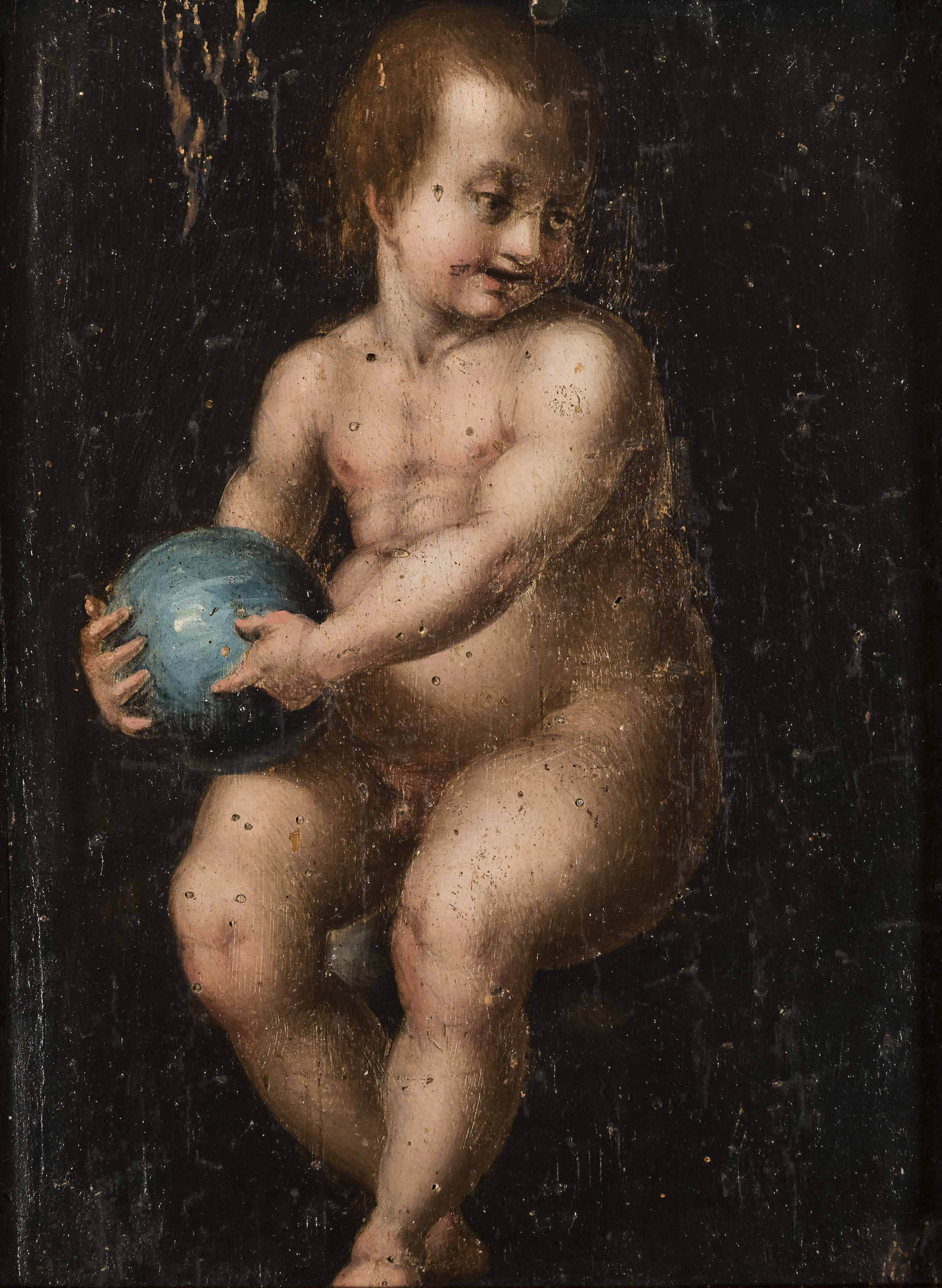
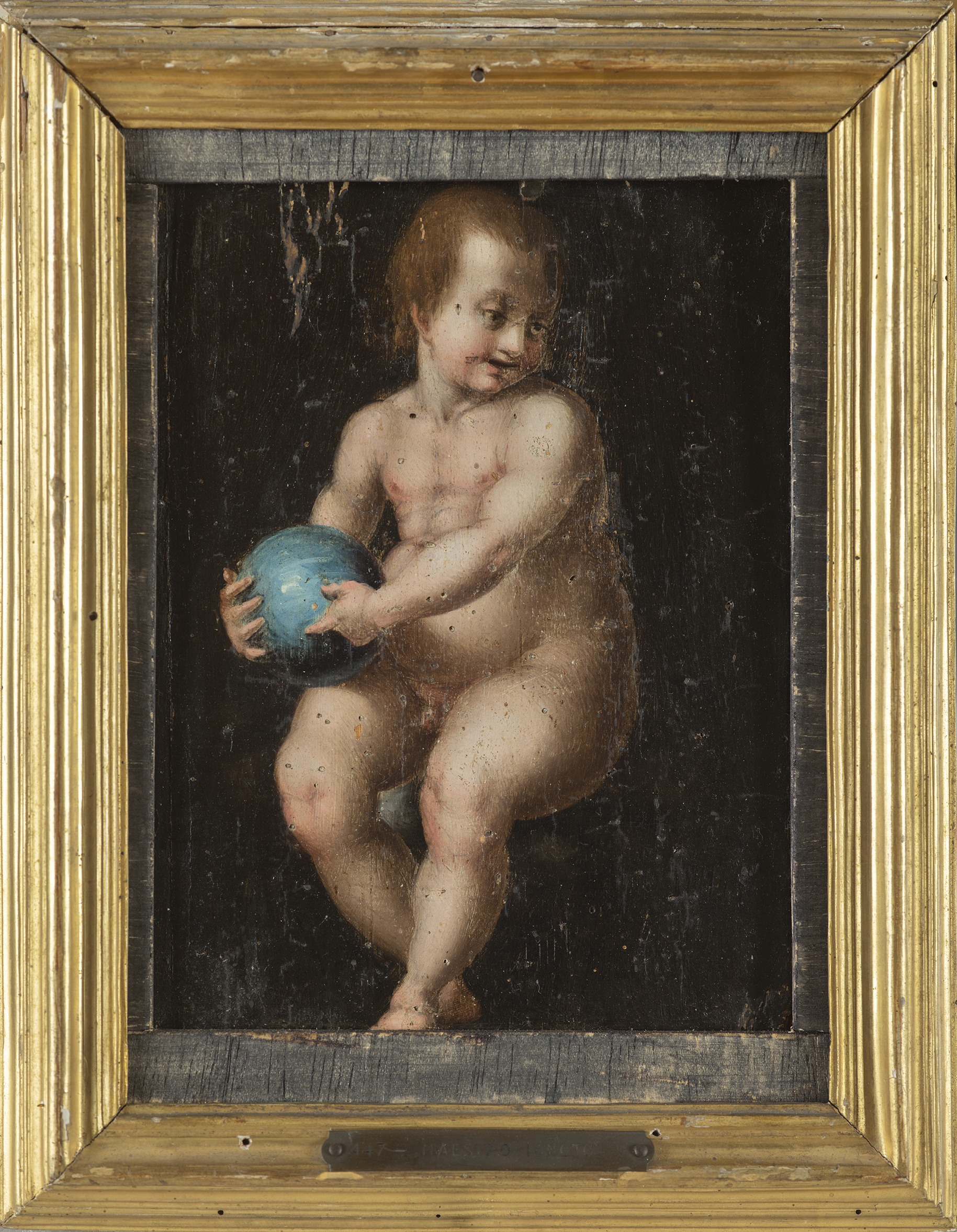
The panel has been in the collection since at least the end of the 17th century; in old inventories and until the end of the 19th century, the work was ascribed to Andrea del Sarto. Later attributed more generically to the Florence school, the picture is not considered to be of great merit, perhaps due in part to its poor state of conservation.
Inventory 1693, room VI, no. 44; Inventory 1790, room VII, no. 50; Inventario Fidecommissario Borghese 1833, p. 30. Purchased by the Italian State, 1902.
Conservation and Diagnostic
1907, Luigi Bartolucci
Catalogue entry
The painting can be identified in the 1693 inventory as the work described as “Sotto al Zampanaro a Capo il letto un quadruccio in tavola alto un palmo in circa con un Bambino con il mondo in mano del No 657 di Andrea del Sarto scritto dietro. Cornice di noce profilata in oro”. The same attribution is recorded in subsequent documents. This attribution was later described as “absurd” by Paola della Pergola (1955), while Adolfo Venturi had already suggested a more general attribution to the Florentine school (1893).
Undoubtedly the work of a painter who studied the Florentine artist Andrea del Sarto cited in the inventory documents, one might consider this panel as belonging to the devotional genre, inspired by the iconography of the Child Jesus seen in the BorgheriniHoly Family in the Metropolitan Museum in New York (inv. 22.75), or a preparatory piece, a sort of sketch, for a more complex work. In fact, the small panel, which is difficult to decipher due to deep scratches and holes produced by woodworm, shows a small Jesus seated with a globe in his hand. This feature recalls the figure of Christ known as “Salvator Mundi” (Saviour of the World), a widespread tradition in Northern European Renaissance painting, where the globe is surmounted by a cross, with the hand of Jesus in the act of blessing. This type of image was often displayed in pendant with a depiction of the Virgin.